
Recovering from a stroke is rarely a straight path. It can feel unpredictable, overwhelming, and sometimes discouraging. But every so often, a story comes along that reminds you that progress is always possible. Even many years after the injury!
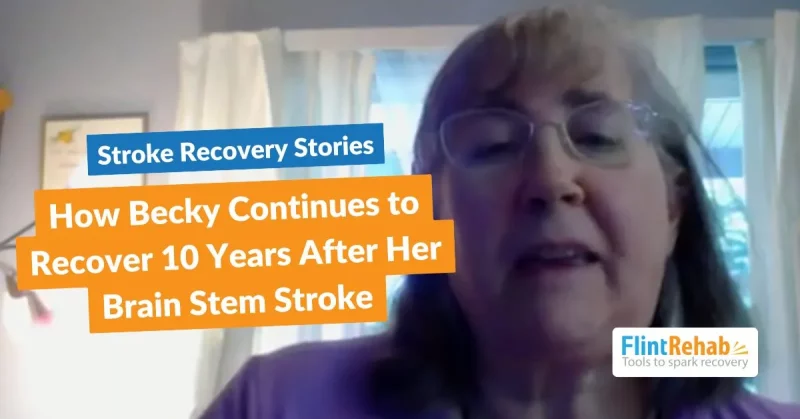
In this article, you’ll meet Becky, a stroke survivor who proves that recovery does not come with an expiration date. Her journey highlights the power of neuroplasticity, the importance of consistent practice, and how the right home therapy tools can open doors when traditional rehab isn’t available.
Becky’s Stroke: A Life-Changing Emergency
In November 2007, Becky experienced an ischemic brainstem stroke, a medical emergency that can affect movement, speech, and essential functions. She was rushed to her local hospital and quickly airlifted more than 100 miles away to a major medical center.
Doctors performed surgery to remove a blood clot from her brainstem. When Becky woke up nearly a month later, her life had changed dramatically.
The stroke left her paralyzed from the nose down. Her doctors told her husband that this paralysis would likely be permanent. But her body had different plans.
The First Signs of Recovery
Nearly a month later, Becky woke up and discovered she had full movement on her right side and partial movement on her left side. She could also feel everything on her left side, which was an encouraging sign early in her recovery.
However, even with this improvement, Becky still faced significant challenges:
- She couldn’t walk.
- Her left hand was tightly clenched due to severe spasticity.
- Her left ankle was stiff and difficult to control.
- Speaking clearly was physically tiring and difficult.
These symptoms are common after brainstem strokes, and many survivors rely heavily on therapy during the first year to regain movement and function.
But unfortunately, Becky didn’t receive the support she needed during this time.
The Problem With “Old School” Stroke Thinking
When Becky had her stroke, a common belief in rehabilitation was that recovery stopped after one year. Many people were told that if they didn’t regain function within those first 12 months, improvement after that point it was unlikely they would see much improvement.
Because of this mindset, Becky didn’t receive ongoing therapy for several years, even though she still felt potential for more progress. Eventually, multiple therapists in her area declined to take her on as a patient, believing she was “too far out” from her stroke.
It was discouraging. But Becky wasn’t ready to give up.
Discovering Flint Rehab and a New Path Forward
Years into her recovery, Becky discovered Flint Rehab and the home-based therapy tools designed specifically for stroke survivors. She purchased the MusicGlove and the Flint Fit DVD Program, and those tools became a turning point in her journey.
When she started using them:
- Her left hand was clenched so tightly she could barely open it.
- She relied on a wheelchair for mobility.
With consistent practice, things began to change.
Regaining Hand Function With MusicGlove
MusicGlove is a hand therapy device that uses rhythm, repetition, and real-time feedback to help improve hand movement. For Becky, it made a measurable difference.
Before using MusicGlove, according to Becky,“Her hand remained clenched in a tight fist.”.
However, after consistently using the MusicGlove for just a short time, she can now partially open her hand.
These gains may seem small to someone who hasn’t experienced a stroke, but for survivors, even a few degrees of movement can unlock independence like holding objects, self-care tasks, and confidence in daily life.
Improving Mobility After Years of Limited Progress
Before discovering Flint Rehab, Becky spent much of her time in a wheelchair. She thought walking again might be out of reach. But with regular practice using her home therapy tools and exercises, she now walks with assistance.
Her next big goal: walking without a cane or walker.
That’s the power of consistency. When the brain practices movement over and over, it creates new neural pathways, even years after the injury.
Fighting Against Discouragement and Outdated Beliefs
One of the hardest parts of Becky’s journey wasn’t the physical recovery. It was being turned away by therapists who believed she couldn’t improve.
“Therapists cling to the old school thinking and many have refused to take me as a patient.”
This experience is more common than many people realize. But Becky’s progress is a reminder that improvement is possible long after the first year, especially with the right tools and support.
Becky’s Message to Other Stroke Survivors
If you take only one message from Becky’s story, let it be this:
“I’m living proof that with proper therapy there is no time limit on stroke recovery.”
Recovery doesn’t stop at 12 months. It doesn’t stop at 5 years. And it certainly doesn’t stop because someone tells you it should. With consistent practice, the right strategies, and perseverance, the brain can continue adapting.
Why Becky Recommends Flint Rehab
Becky credits a big part of her progress to tools like MusicGlove and the Flint Fit exercises. These programs helped her keep practicing at home when she didn’t have access to therapy.
She recommends Flint Rehab because:
- The tools provide structure, variety, and motivation.
- They support neuroplasticity, which drives improvements in mobility and coordination.
- They empower survivors to take charge of their recovery at home, even if local therapy options are limited.
For Becky, the combination of repetition, guided exercises, and feedback helped her make breakthroughs she hadn’t seen in years.
Learn more about Flint Rehab Home Recovery Tools
Final Thoughts: Hope Never Expires
Becky’s journey is a powerful reminder that recovery is not limited by time but by effort, support, and belief in what’s still possible.
Whether you’re early in your recovery or many years post-stroke, your brain can continue to change. Progress may be slow at times, but it is real, and it is achievable. If you’re looking for motivation or proof that recovery continues far beyond the first year, Becky’s story shines brightly:
Keep going. Keep practicing. And don’t let anyone tell you your progress has an expiration date!