
Therapy putty is one of the simplest tools for rebuilding hand strength at home as it’s cheap, it fits in a pocket, and you can use it while watching TV. But if you just got a tub of it, you may have questions.
What does it do?
Which strength do you need?
How do you use it to get the best results?
That’s what this guide is for. Below, we’ll explain what therapy putty is and how to pick the right resistance. We’ll also share how to get the most from each session. and then we’ll walk you through 8 therapy putty exercises you can start today, plus a free printable PDF.
Let’s dive in!
Table of contents
- What Is Therapy Putty and What is It Made From?
- Who Can Benefit from Therapy Putty?
- Therapy Putty Resistance Levels
- Hand Therapy Putty Exercises For You to Try
- Hand Therapy Putty Exercises PDF
- Does Therapy Putty Work for Hands?
- How To Care for Your Putty
- Therapy Putty FAQ
- Moving Forward with Therapy Putty
- Additional Resources
What Is Therapy Putty and What is It Made From?
Therapy putty is a soft, stretchy material you squeeze, pinch, and pull to work your hand and finger muscles. You may also hear it called therapeutic putty, hand putty, exercise putty, or TheraPutty.
Most therapy putty is made from silicone and NHS hand therapists describe it as a stretchy, silicone-based exercise material used for hand therapy after hand surgery or injury. It’s also common in stroke rehab, arthritis care, and pediatric occupational therapy. With therapy putty, the putty sort of pushed back as you squeeze and this resistance is what makes your muscles work.
Depending on the exercise, you can roll it into a ball, a rope, or a flat pancake meaning one tub of different resistance strengths can train all types of things like grip, pinch, finger straightening and more!
Who Can Benefit from Therapy Putty?
Therapy putty can help almost anyone who wants a stronger, more coordinated hand. Physical and occupational therapists use it in clinics and send it home with patients for practice between sessions.
People who often use therapy putty include:
- Stroke and brain injury survivors working on hand recovery and hand paralysis.
- People with arthritis who want to keep their hands moving and maintain grip.
- People recovering from hand or wrist surgery or injury, once their surgeon or therapist says it’s safe.
- Older adults who want to keep their grip strong for daily tasks.
- Kids in occupational therapy working on fine motor skills like writing and using scissors.
If you’re unsure whether putty is right for your hand, ask your therapist before you start. This is especially important after surgery or if you have a joint that’s swollen or painful.
Therapy Putty Resistance Levels
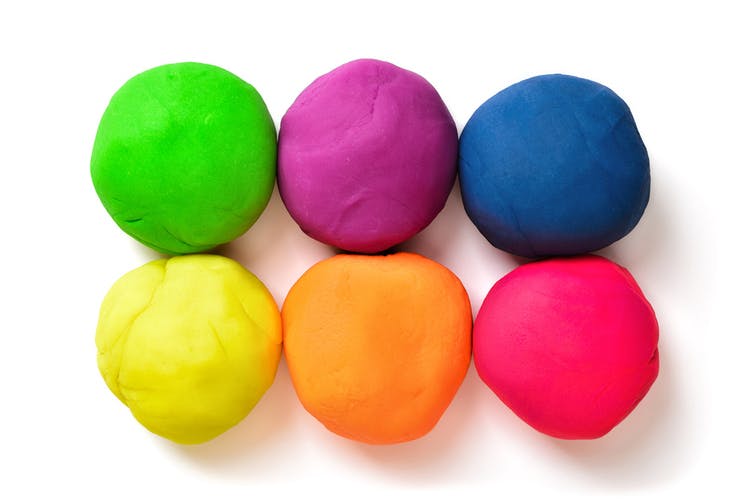
Therapy putty comes in different strengths, often called resistance levels. Each level is usually a different color. Softer putty is easier to squeeze. Firmer putty makes your muscles work harder.
Here’s a simple guide to the common levels:
| Resistance | How it feels | Often a good fit for |
|---|---|---|
| Extra soft | Squishes with very little effort | Very weak hands, early recovery, arthritis flares, young kids |
| Soft | Light push back | Building basic grip and finger control |
| Medium | Moderate push back | People who can do soft putty easily for full sets |
| Firm | Strong push back | Building strength once control is good |
One thing to keep in mind is colors are not universal. Each brand uses its own color system. A “red” from one brand may not match a “red” from another. Always check the label. Flint Rehab’s therapy putty comes in color-coded levels from extra soft to firm, so you can step up as your hand gets stronger.
Hand Therapy Putty Exercises For You to Try
The following hand therapy putty exercises were created to accompany our therapy putty pack available on Amazon.
These exercises move from easier to harder. Start with the ones that feel doable and add more as you improve. If you can’t do a movement on your own yet, use your other hand to help.
Try to accomplish these exercises on a daily basis to stimulate neuroplasticity and create strength and coordination and remember, assisted practice still gives your brain the repetitions it needs.
FREE PDF: Want all of these exercises in a convenient PDF? Download it for free here.
Power Grip
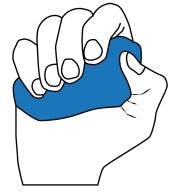
The power grip is the first exercise in our list of eight therapy putty exercises. This exercise is helpful for all ability levels. Grab your putty and squeeze it using all five fingers, then relax. Repeat this several times for a strengthening and therapeutic effect.
How to perform
- Hold the putty in your palm.
- Squeeze it using all five fingers.
- Relax and reshape the putty.
- Repeat 10 times.
Why it helps: this builds the basic grip you need to hold a cup, a railing, or a bag handle.
Full Grip

For this hand flexion exercise, roll the putty into a ball and hold it in your palm. Then, press all your fingers except the thumb into the putty. This exercise adds one layer of challenge to the previous exercise by removing the muscular thumb from helping.
How to perform:
- Roll the putty into a ball and hold it in your palm.
- Press all your fingers into the putty, but keep your thumb out of it.
- Relax and repeat 10 times.
Why it helps: taking away the strong thumb makes your finger muscles do all the work.
Finger Scissors
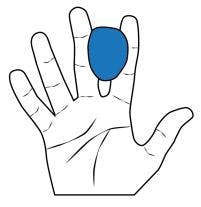
Next in your hand therapy putty exercises, roll your putty into a ball and squeeze it between your fingers. Try doing it with all your fingers to give your hands extra therapy. Squeeze between your index finger and middle finger. Then, your middle finger and ring finger. Then, your ring finger and little finger.
You can use more or less putty to change the size of the ball and, therefore, modify the challenge and adapt to the size of your hand.
How to perform:
- Roll a small ball of putty.
- Place it between your index and middle fingers.
- Squeeze your fingers together, then relax. Repeat 10 times.
- Move to the middle and ring fingers, then the ring and little fingers.
Why it helps: this strengthens the small muscles between your fingers. Those muscles help you hold flat objects, like a card or a piece of paper.
Finger Spread
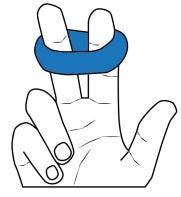
Roll the therapy putty out into a cylindrical shape and then wrap it around two fingers to form a donut shape. Then, spread your fingers apart. This resistance exercise focuses on extending the muscles that were flexed in the previous exercise.
How to perform:
- Roll the putty into a short rope.
- Wrap it around two fingers to make a donut shape.
- Spread your fingers apart against the putty.
- Relax and repeat 10 times.
Why it helps: this works the muscles that spread your fingers. That’s the opposite motion from the finger scissors.
Fingertip Pinch
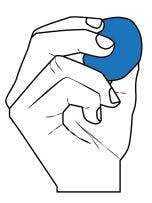
Roll your hand therapy putty into a ball and pinch it using your thumb and fingertips. If you have spasticity in your hand that makes it difficult to move each finger individually, press all fingers into the putty at once. As you improve, try to press each finger individually into the putty. For help with tight, stiff fingers you can also see these stretching exercises for hand spasticity.
How to perform:
- Roll the putty into a ball.
- Pinch it between your thumb and each fingertip, one at a time.
- Repeat 10 times with each finger.
Why it helps: fingertip pinch is the motion you use to pick up coins, pills, or a button.
Flat Pinch
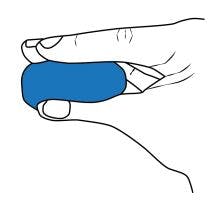
Straighten your fingers as best you can, and pinch the putty between your fingers and thumb. This differs from the previous exercise because the fingers remain straight instead of curled, therefore different muscles are being utilized. This is a strengthening hand therapy putty exercise.
How to perform:
- Straighten your fingers as best you can.
- Pinch the putty between your straight fingers and your thumb.
- Relax and repeat 10 times.
Why it helps: keeping your fingers straight works different muscles than a curled pinch. This grip helps with holding a plate or a book.
Full Finger Spread
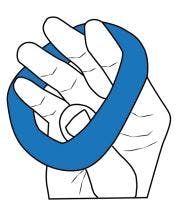
Roll the putty out into an even longer cylindrical shape than before and wrap it around all your fingers to form a circle. Then, spread your fingers apart. This movement targets extension of your finger joints instead of flexion.
How to perform:
- Roll the putty into a longer rope.
- Wrap it around all your fingers and thumb to form a circle.
- Open your hand wide against the putty.
- Relax and repeat 10 times.
Why it helps: this trains your hand to open, not just close. Opening your hand is key for letting go of objects and reaching for new ones.
Finger Extension
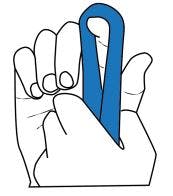
Number 8 in our list of therapy putty exercises asks you to roll the putty out and wrap it around one finger while the finger is bent. Then, extend (straighten) the finger while using the putty to provide resistance. This is an advanced hand therapy putty exercise. If you struggle with this movement, try again in a few weeks.
This is the most advanced exercise on the list.
How to perform:
- Bend one finger and loop the putty over the tip.
- Hold the ends of the putty down with your other hand.
- Straighten the finger against the putty.
- Repeat 10 times with each finger.
Why it helps: the muscles that straighten the fingers are often the weakest after a stroke. Strengthening them can make it easier to open your hand around objects.
When you’re ready for more: progress one thing at a time. Add reps, move up one putty level, or slow each rep down. For more ideas beyond putty, try these hand therapy exercises and finger opposition exercises.
Hand Therapy Putty Exercises PDF
Want all of these exercises in a convenient little PDF? Download it for free here.
Does Therapy Putty Work for Hands?
Research suggests therapy putty exercises may help improve hand strength and coordination, but the findings depend on the condition being treated.
In a randomized controlled study of 60 people with Parkinson’s disease, researchers tested a single 15-minute hand-exercise session using therapy putty. They reported improvements in dexterity, grip strength, and pinch strength immediately afterward.
For stroke recovery, putty has been included in successful rehabilitation programs. A randomized trial of 103 stroke survivors tested a four-week supplementary exercise program called GRASP, which combined putty exercises with stretching, other strengthening exercises, and everyday hand tasks. Participants who received the program improved more in grip strength and arm-and-hand function than those who received an education program alongside their usual rehabilitation. However, because putty was only one part of GRASP, the study cannot tell us how much of the benefit came from putty itself.
Putty has also been used in research involving hand osteoarthritis. In a randomized trial of 151 people, a program combining putty exercises, other hand exercises, and advice on managing daily activities improved grip strength after eight weeks compared with routine care plus a placebo cream. Again, the results support the combined program rather than proving that putty alone produced the improvement.
The takeaway: therapy putty is a beneficial hand exercise tool and putty based exercises may help but should be combined as part of a larger program targeting your specific challenges and condition.
How to Get the Best Results
Therapy putty works by giving your hand muscles steady, repeated work. After a stroke or brain injury that practice helps the brain rebuild the connection to your hand in addition to improving the strength and coordination.
This happens through neuroplasticity or the brain’s ability to rewire itself based on what you practice. Each time you try to squeeze, pinch, or open your hand, you send a signal that this movement matters. With enough repetition, the brain adapts.
Here’s how you can make each session count:
- Aim for 10 reps per exercise. Do 2 to 3 sets, resting between them. Follow your therapist’s numbers if they gave you different ones.
- Go slow. A slow, controlled squeeze works your muscles more than a quick one. Try a slow count of 3 to squeeze, then relax.
- Be consistent. Daily practice is great, but it isn’t the only option. In a trial of 36 adults age 55 and older, putty exercises every other day built about the same hand strength over 8 weeks as daily practice. Pick a schedule you can keep.
- Balance closing with opening. Squeezing trains the muscles that close your hand. Many survivors also need to work on opening it. Include the finger spread and finger extension exercises in every session.
- Tie it to a real task. Think about why you’re practicing. If your goal is to hold a cup, finish your session by practicing with a real cup.
One thing to keep in mind is don’t just try to squeeze as hard and fast as you can. Speed and force feel productive but slow careful reps with good form build better control and that control is what carries over to daily life.
How To Care for Your Putty
Making your putty last means taking proper care as this will help keep the putty clean, keep its resistant ance steady, and help you get the most out of it over time. Here are some tips to help you do exactly that:
- Store it in its container with the lid closed when you’re done.
- Keep it off fabric and carpet. Putty can stick to and stain clothing so work over a table or a plate.
- Wash your hands before and after each session. Lotion and dirt can change how the putty feels.
- Keep it away from small children and pets unless an adult is watching. Putty is not safe to eat.
- Replace it if it gets dirty, sticky, or starts to feel different.
If putty gets stuck in fabric don’t rub it as this will just push it deeper. Hold an ice pack on it until it firms up, then gently pick it off. After that, follow the care tips from your putty’s maker.
Therapy Putty FAQ
What is therapy putty used for?
Therapy putty is used to build hand strength, grip, pinch, and finger control. Therapists use it after stroke, brain injury, hand surgery, and injury. It’s also used for arthritis and to help kids build fine motor skills.
Does therapy putty dry out?
Silicone putty usually does not dry out the way clay or play dough does. Keeping it sealed in its container helps it last longer. Replace it if it gets dirty or its feel changes.
How often should I use therapy putty?
Many people practice once a day, but every other day can work too. In one trial, both schedules built similar hand strength over 8 weeks. The best schedule is the one you’ll stick with.
Where can I buy therapy putty?
You can find therapy putty at medical supply stores and online. Flint Rehab offers a color-coded therapy putty set with progressive resistance levels for home practice.
Moving Forward with Therapy Putty
Therapy putty won’t do the work for you but it makes the work simple, portable, and easy to track. A few slow, focused sets most days can help your hand get stronger and more coordinated over time.
Start with the softest putty you can use with good form. Pick 3 or 4 exercises, including at least one that opens your hand and then ask your therapist at your next visit: “Which putty level and which exercises should I focus on for my goals?”
We hope you enjoyed this article and subscribe to our newsletter for weekly articles just like this delivered straight to your inbox — subscribe here.
Additional Resources
Here are some additional articles you might be interested in:
- 39 Restorative Hand Therapy Exercises that Promote Strength and Dexterity: Go beyond putty with a full library of hand exercises for every ability level.
- Best Physical Therapy Tools for Hands: Improve Strength, Mobility, and Function With Rehab Tools at Home: See which home tools pair well with putty and what each one trains.
- Try These 8 Hand Therapy Ball Exercises For Stroke Patients to Improve Fine Motor Skills: Add a therapy ball to your routine for even more grip and finger practice.
- 8 Stretching Exercises for Hand Spasticity After Stroke To Increase Mobility: Loosen tight fingers before your putty session so you can move with better form.
- Finger Opposition Exercises: Improve Hand Coordination, Dexterity, and Fine Motor Skills with Finger-Thumb Opposition: Build the thumb-to-finger control you need for buttons, zippers, and pens.