
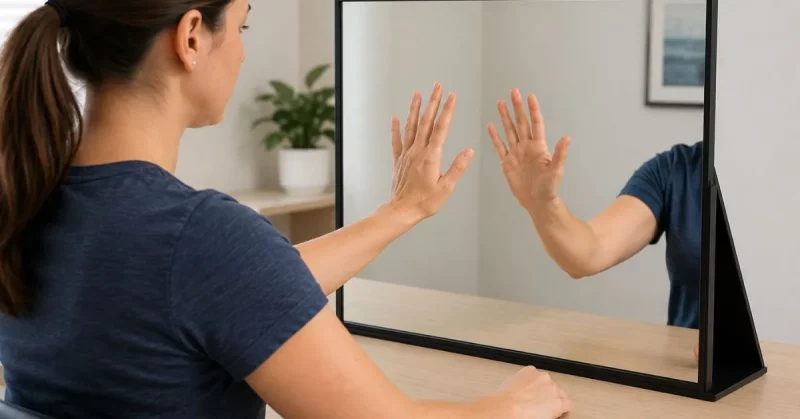
Why would watching your good hand move in a mirror help your weaker hand recover? It sounds like a trick, and in a way, it is. Mirror therapy uses a simple visual illusion to convince your brain your affected limb is moving. That illusion can spark real changes in how your brain controls movement.
Understanding why this works is the first step, and there’s a lot more to know before you try it yourself.
Let’s dive in!
Table of contents
What Is Mirror Therapy?
Mirror therapy uses a mirror to create a reflection of your unaffected arm or leg. By positioning a mirror in the center of your body facing your unaffected limb, you can create a reflection that looks like your affected limb. Then you hide the affected limb behind the mirror and move the unaffected one while watching its reflection.
This creates an illusion. Your brain watches what looks like smooth movement in your affected limb. It starts to respond as if that movement is real. This technique was first built to treat phantom limb pain in amputees.
Researchers later found it could also help people recover movement after stroke, traumatic brain injury (TBI), and spinal cord injury (SCI).
It’s low-cost, low-risk, and needs no special equipment beyond a mirror and that’s part of why it’s stuck around in rehab clinics for decades.
Why Mirror Therapy Works: The Brain’s Mirror Neuron System
Your brain has a network of cells called mirror neurons. They fire when you perform a movement. They also fire when you simply watch someone else perform it.
Mirror therapy uses this system to its advantage.
It looks like your affected limb is moving, so your brain’s movement-planning areas switch on as if it actually is.
Brain scans back this up. Watching a mirror reflection of a moving hand triggers activity in the motor planning areas of the brain, the same regions used to plan and control real movement.
Other research used resting-state MRI to study people after mirror therapy. Those who improved the most showed stronger connections between the two sides of the motor cortex. In simple terms, the healthy side of the brain was stepping in to help support the injured side.
This matters because of neuroplasticity: your brain’s ability to rewire itself through repeated practice. Mirror therapy doesn’t skip that process. It gives your brain a way to practice a movement pattern even when your body can’t do it alone yet.
That repetition is exactly what neuroplasticity runs on.
How Mirror Therapy Helps After Stroke
Most mirror therapy research has focused on stroke, and the results are encouraging. A 2023 review pooled results across multiple studies of stroke survivors. It found a real, measurable improvement in upper limb motor function among people who used mirror therapy compared to those who didn’t.
What Many People Get Wrong: They assume mirror therapy only works if you already have some movement in your affected arm. That’s not true.
One of its biggest advantages is that it works even with severe paralysis, because it doesn’t require the affected limb to move at all.
You only move the unaffected side. That makes it a realistic starting point for survivors who aren’t ready for more demanding, movement-based therapies yet.
Mirror therapy is typically used for the hand and arm. Some protocols apply it to the leg too, especially for foot and ankle control. However, current research in this area is more limited.
Results vary based on where the stroke happened and how severe it was. It works best as one part of a broader rehab plan, not a standalone fix.
How to Try Mirror Therapy at Home
You don’t need special equipment to get started. Here’s a simple setup:
- Get a sturdy mirror, ideally at least 12 by 16 inches, that can stand upright on its own, or build a mirror box from a cardboard box and a mirror glued firmly to one side.
- Sit at a table and place the mirror upright in front of you, positioned so it runs down the center of your body.
- Hide your affected limb behind the mirror, out of your line of sight, and rest your unaffected limb in front of it, facing the mirror.
- Focus on the reflection, not your actual limb, while you move your unaffected side through slow, simple motions: opening and closing your hand, bending your wrist, or flexing your ankle.
- Watch the reflection like it’s your affected limb moving. This is the part that actually drives the brain response, so give it your full attention rather than treating it as background activity.
While many individuals initially move only their unaffected limb, it is recommended to attempt to move your affected limb simultaneously through the same motions, while still watching the reflected image rather than what your affected limb is actually doing. With consistent practice, you may notice your affected limb starting to move more accurately.
A Simple Mirror Therapy Schedule for Home
Most protocols run 20 to 30 minutes a session, several days a week, for several weeks. There’s no single required schedule. Consistency matters more than any one session’s length. A routine you can actually stick to three or four times a week will do more for your brain than one long session now and then.
As you progress, make the movements harder. Try single-finger isolation instead of a full-hand grasp. Try picking up small objects instead of just opening and closing your hand.
That kind of rising challenge is what keeps neuroplasticity working in your favor instead of stalling out.
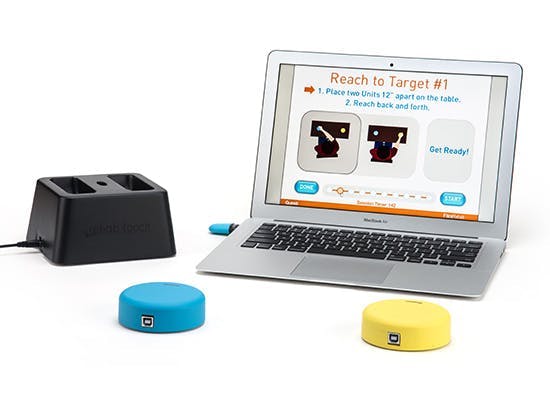
Mirror therapy also pairs well with hand devices built for high-repetition practice, like MusicGlove, which turns finger movements into a music-based game. While neither one replaces guided therapy with a licensed professional, but both give you a way to rack up meaningful repetitions between sessions.
Moving Forward
Mirror therapy isn’t a cure, and it won’t work the same way for everyone. But it’s one of the few rehab tools that’s low-cost, easy to start at home, and backed by real brain-imaging evidence. It does what it claims: it engages the motor areas of your brain even when your body can’t move on its own yet.
If you’re not sure whether mirror therapy fits your recovery, bring it up with your occupational or physical therapist. They can help you pick the right movements, frequency, and progression for where you are right now, and adjust the plan as your recovery continues.
We hope you enjoyed this article and subscribe to our newsletter for weekly articles just like this delivered straight to your inbox — subscribe here.
Here are some additional articles you might be interested in:
- Mirror Therapy for Stroke Patients: How It Helps with Paralysis Recovery
- Neuroplasticity Exercises After Stroke: 10 Strategies to Rewire Your Brain for Recovery
- Neuroplasticity Exercises for Brain Injury (TBI): 30 Therapist Recommended Activities to Help Recovery
- Regaining Hand Function After Spinal Cord Injury: 7 Proven Strategies to Boost Recovery
- Maximizing Hand Recovery After Stroke: How to Improve Hand and Finger Mobility