
After a stroke, brain injury, or spinal cord injury, a muscle can seem like it has stopped listening. You tell your hand to open, or your foot to lift, and nothing happens.
That gap between wanting to move and actually moving is one of the hardest parts of neuro recovery. Often the muscle itself is still healthy. The signal telling it to fire just isn’t getting through.
This is where electrical stimulation therapy comes in. It’s one of the few tools that can make a weak or paralyzed muscle contract, even when the brain’s own signal can’t reach it. It’s also backed by decades of research in stroke, brain injury, and spinal cord injury rehab.
The good news is that electrical stimulation isn’t just something you sit through. Used well, it becomes a way to practice the exact movements you’re trying to relearn.
In this article, we’ll explain how it works, what the research shows, and how it usually fits into a home recovery routine.
How Electrical Stimulation Retrains Muscles
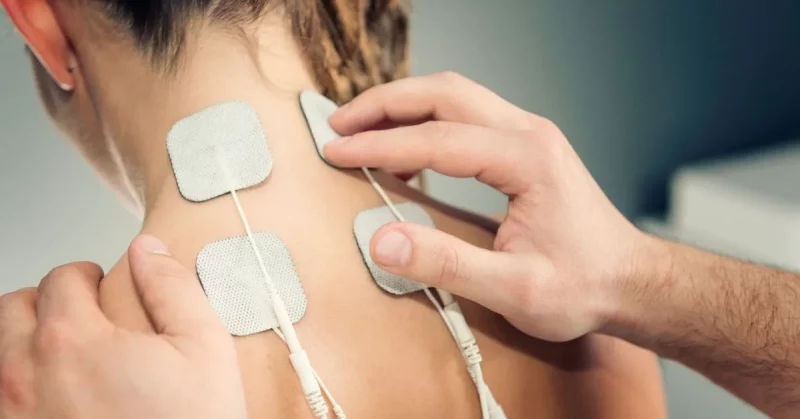
Electrical stimulation therapy works by placing electrodes on the skin over a weak or paralyzed muscle. The electrodes send mild electrical pulses through the skin to the nerve that controls that muscle. That pulse triggers the nerve, telling the associated muscle to contract.
In simple terms, the device recreates the signal a healthy brain would normally send on its own.
This matters because after a stroke or brain injury, the muscle usually isn’t the problem. The damage is in the brain’s ability to send it a strong, clear signal.
Electrical stimulation for stroke patients works around that gap. It activates the muscle directly, giving it the contraction it isn’t getting on its own.
For spinal cord injury, the mechanism works a little differently. While the brain is able to send a signal telling the muscle to contract, that signal may be disrupted before reaching the muscle at the level of injury. Electrical stimulation can activate the nerves that control muscles below the level of injury.
This lets those muscles contract even though the pathway connecting them to the brain has been disrupted. Research on electrical stimulation for spinal cord injury has looked at how these repeated contractions may help preserve muscle activity and support movement over time.
Why Repetition From Stimulation Supports Neuroplasticity
Every muscle contraction from electrical stimulation sends signals back up to the brain and spinal cord. It’s not just a local twitch. Repeating that signal, over and over, is exactly the kind of input that drives neuroplasticity. Neuroplasticity refers to the brain and spinal cord’s unique ability to rewire themselves and strengthen the neural pathways that are used most.
Research on stroke recovery backs this up. A review of the effect of NMES devices on neuroplasticity found that repeated stimulation can change how the brain and spinal cord handle movement. That’s a bigger effect than just making one muscle stronger.
Some studies used brain scans and found more activity in motor areas after a course of stimulation. That suggests the therapy is reinforcing the whole pathway, not just the muscle at the end of it.
This is also why stimulation tends to work best as part of a steady routine, not one session. Stimulate a muscle a few times a week, and pair it with an attempt at the same movement.
That gives the pathway far more chances to strengthen than a single session ever could.
The Main Types of Electrical Stimulation Used in Neuro Rehab
Not all electrical stimulation does the same job. Three types show up most often in neuro rehab:
- NMES (neuromuscular electrical stimulation) activates a muscle on a set cycle, no matter what you’re doing at that moment. It’s typically used to build strength, slow muscle loss, and get a stiff or spastic muscle moving again.
- FES (functional electrical stimulation) times the pulse to a specific task. It might fire as you lift your foot mid-step, or as you open your hand to grasp a cup. This is the type used in FES devices for foot drop, since the goal is to support the actual movement, not just fire the muscle on its own.
- TENS (transcutaneous electrical nerve stimulation) uses a different setting aimed at easing pain, not producing a muscle contraction. It doesn’t retrain movement the way NMES or FES do, and mixing the two up is common. Our guide on NMES vs. TENS breaks down exactly how they differ.
What Many People Get Wrong: Assuming any device with electrodes does the same thing. If the goal is retraining a movement, NMES or FES is the right tool. Conversely, TENS is built for pain relief, not for re-training muscles.
What the Research Says About Function and Recovery
The research on electrical stimulation is strongest in two areas: hand and arm recovery, and walking with foot drop.
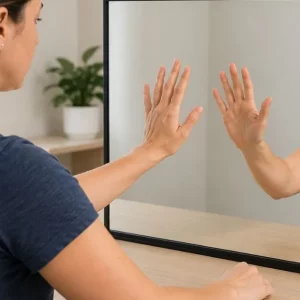
For the upper body, one trial tested a device that ties stimulation of the affected hand to movement of the good hand. This “mirrored” FES improved hand dexterity more than standard stimulation alone. The person is actively starting the motion, not just receiving a preset pulse. That piece of active intent seems to matter for how well the movement carries over into daily tasks, like picking up a cup.
For gait, a trial on FES for foot drop after stroke found real gains in ankle control and walking pattern. Other research on NMES and gait in chronic stroke found benefits for people with limited ankle control, even years after their stroke.
That last point matters. It pushes back on the idea that stimulation only helps early on. Progress isn’t locked to a fixed window after injury.
Stimulation may also ease spasticity: the tightness or stiffness that often builds up in an affected limb. One review on NMES and spasticity after stroke found that stimulating a tight muscle, or the muscle that opposes it, can reduce that excess tightness. This may work by changing how the spinal cord handles signals to that muscle.
Our article on spasticity treatments covers where stimulation fits alongside stretching and other options.
How Electrical Stimulation Fits Into a Home Recovery Routine
Electrical stimulation is rarely used alone. It works best paired with your own attempt to move your affected limb. That combo seems to reinforce the path from brain to muscle, not just the muscle itself.
However, if you can’t move a limb on your own yet, stimulation can still help. It lets you practice the pattern of a movement, like opening your hand or lifting your foot, before you can do it on your own.
Think of it as a bridge.
The assisted reps still count as practice and many people find they can add a little more of the movement themselves as time goes on. Even simply visualizing yourself performing the movement during e stim sessions can help improve the connection between the brain and the muscles.
As your own control improves, the device can offer less help. Some devices only kick in for the part of the movement you can’t yet do on your own. This kind of step-by-step progress mirrors how repetitive task training works across neuro rehab. You start where you are, and the challenge grows as you improve.
Stimulation also helps prevent setbacks. Muscles that sit unused for long stretches after a stroke or spinal cord injury tend to waste away, a problem called muscle atrophy.
Regular stimulation can help keep those muscles active while your own movement is still coming back.
What to Know Before Starting
Don’t start electrical stimulation on your own without guidance.
A physical or occupational therapist can help pick the right device, electrode placement, and settings for your specific situation. They can also tell you if stimulation is safe given your medical history. For example, it isn’t recommended for people with certain implanted devices, like pacemakers, and placement needs to be precise to reach the right muscle.
Home electrical stimulation devices are meant to support the work you’re doing with a therapist, not replace it.
If you’re curious about adding stimulation to your routine, a good place to start is asking your therapist these questions:
- Which muscles would benefit most from electrical stimulation right now?
- Would NMES or FES better match my current goals?
- How many sessions per week would actually make a difference?
- How will we know if the settings need to change as I improve?
Moving Forward
Electrical stimulation therapy won’t replace the work of relearning a movement. But it can give a muscle the signal it needs to start participating again.
Paired with steady practice and guidance from a therapist, it becomes one more way to give the nervous system the repetition it needs to change.
And while progress with any single tool tends to be gradual, small gains add up over time!
We hope you enjoyed this article and subscribe to our newsletter for weekly articles just like this delivered straight to your inbox. Subscribe here.
Here are some additional articles you might be interested in:
- Electrical Stimulation for Stroke Patients: How This Treatment Benefits Recovery
- NMES vs TENS: Comparing the Popular Electrical Stimulation Options for Rehab
- Functional Electrical Stimulation (FES) Device for Foot Drop: Can It Really Help You Walk Again?
- How Spasticity Treatment Works: Understanding Exercise, Botox, & Add-On Therapies
- Muscle Atrophy After Stroke: Causes and Solutions for Recovery