

Quick Summary
- Aphasia is a language disorder that affects speaking, understanding, reading, and writing, often after stroke or brain injury.
- Aphasia affects communication, not intelligence. Your loved one is still the same person inside.
- Small communication changes like slowing down, reducing distractions, and using simple questions can make conversations easier.
- Visual tools, gestures, and yes/no questions often help reduce frustration.
- Patience and giving extra time to respond can significantly improve communication.
- Consistent communication practice may help support long-term recovery through neuroplasticity.
Imagine knowing exactly what you want to say, but when you open your mouth, the words refuse to cooperate. Perhaps a completely different word slips out instead, or maybe the speech clogs in your throat entirely.
This is the daily reality of living with aphasia. It is a neurological condition that alters a person’s ability to process, express, and/or understand language and impacts over two million people in the United States alone.
When a loved one experiences aphasia, the sudden communication barrier can feel profoundly isolating for everyone involved. Conversations that used to flow naturally can suddenly feel like navigating an obstacle course.
However, here is one of the most important things to understand: aphasia affects language, not intelligence.
Your loved one is still completely present inside, with the same thoughts, memories, humor, and depth they always possessed. They simply require a different avenue to let those thoughts out.
In this guide, we will teach you some simple tips for how to communicate more effectively with someone who has aphasia. We will explore practical strategies, common pitfalls to avoid, and how you can support your loved one’s long term recovery in a more positive way.
Let’s dive in!
Table of contents
- What Is Aphasia (and What It Is Not)?
- Simple Tips for Improving Communication With Someone Who Has Aphasia
- What to Do When the Conversation Gets Stuck
- Practical At-Home Activities for Improving Communication With Aphasia
- A Short Checklist on How to Communicate Better With Someone Who Has Aphasia
- Communication and Living With Aphasia
What Is Aphasia (and What It Is Not)?
Before diving into practical communication tools, it helps to understand what is happening inside the brain. Aphasia occurs when an injury damages the language-dominant hemisphere of the brain, typically the left side.
Depending on where the injury happened, aphasia can manifest in several distinct ways and understanding these differences can change how you approach a conversation.
Let’s take a look at each.
What is Expressive Aphasia (Broca’s Aphasia)?
With expressive aphasia, a person generally understands what you are saying quite well, but they struggle to produce language. They might speak in short, broken phrases, omit small words like “and” or “the,” or labor intensely over a single syllable.
Because they are often acutely aware of their errors, individuals with expressive aphasia can easily become frustrated.
Learn more about Expressive or Broca’s Aphasia
What is Receptive Aphasia (Wernicke’s Aphasia)?
Conversely, receptive aphasia affects a person’s ability to comprehend spoken or written words. A person with receptive aphasia might speak fluently and rapidly, but the words they use may not make sense together, or they might invent entirely new words altogether.
In addition, they may not realize that what they are saying does not match what is in their head.
Learn more about Fluent, Receptive or Wernicke’s Aphasia
What is Global Aphasia?
This is a more widespread form of aphasia, often occurring immediately after a major stroke or severe traumatic brain injury. It impacts both the expression and comprehension of language. While global aphasia presents a profound challenge, the brain possesses a remarkable capacity for healing, and communication can improve over time as the brain adaptively rewires itself through the process of neuroplasticity.
Learn more about Global Aphasia
While there are a number of other types, expressive, receptive and global aphasias are a few of the most common.
What Many People Get Wrong: Because language and intellect are so closely linked in modern society, it is common for people to mistake aphasia for a decline in mental capacity or a memory problem. This is a significant misconception.
A person with aphasia can know exactly who you are, remember their past, and have clear opinions, but they simply have a broken delivery system. Although some individuals may have a co-occurring condition affecting their cognition, this is not the case for many people with aphasia.
Simple Tips for Improving Communication With Someone Who Has Aphasia
Communicating with a loved one who has aphasia can sometimes feel like trying to connect across a massive divide. However, there are some small things you can do to dramatically improve communication.
Here are some simple tips that will help you improve communication with someone who has aphasia.
1. Set the Stage for a Successful Conversation
When you want to talk to someone with aphasia, the environment you choose plays a vital role in how well the conversation goes.
A healthy brain automatically filters out background noise, like a humming refrigerator, a playing television, or a nearby conversation.
However, a brain healing from a stroke or TBI has to work significantly harder to process basic input. Problems with concentration and attention are also common among stroke and TBI survivors, making additional sensory input even more challenging to tune out. Therefore, environments that include unnecessary sensory data can completely derail a conversation.
Here are some suggestions to set the stage for a successful conversation:
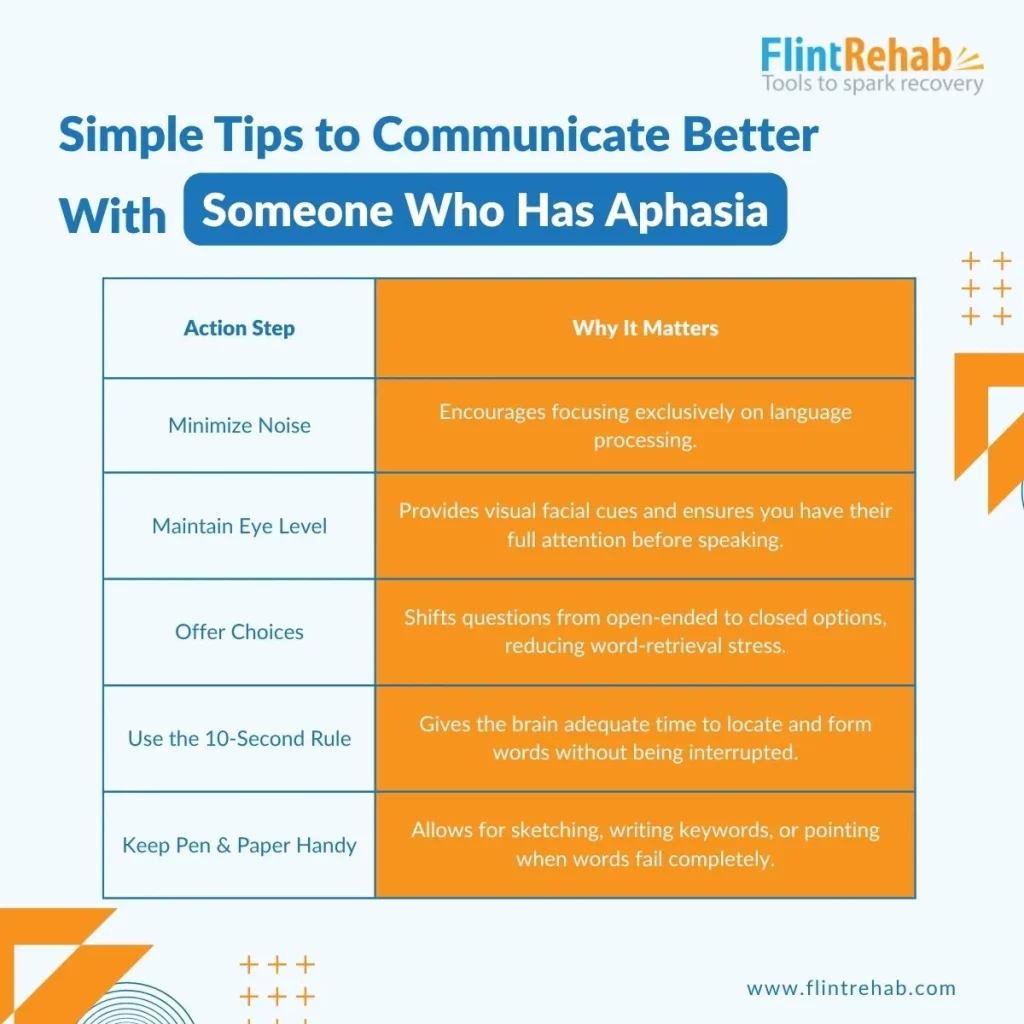
- Eliminate background distractions: Before you begin speaking, turn off the television, pause the radio, or step into a quieter room. By removing competing noises and visual distractions, you allow your loved one to focus all their cognitive energy entirely on your words.
- Ensure you have their complete attention: Walk up to them, establish gentle eye contact, and perhaps place a reassuring hand on their shoulder before you start talking. This physical cue lets them know that a conversation is beginning, preventing them from having to catch up with the first half of your sentence.
- Maintain a natural, respectful posture: Sit or stand at eye level. Avoid talking to them from across the room or while walking away into the kitchen. Being physically present and visible provides essential visual context, such as facial expressions, non-verbal communication cues and lip movements, which helps the brain decode your speech much more effectively.
While these might seem small, they help set you and your loved one up for success from the start.
2. Adapt Your Approach, Not Your Tone
When a conversation stalls, our natural instinct is often to raise our voice or speak as if we are talking to a toddler. While this is well-intentioned, it can feel deeply discouraging and patronizing to an adult with aphasia.
Instead, the goal is to simplify your linguistic structure while keeping your tone mature and respectful.
To achieve this balance, try implementing these structural adjustments during your daily interactions:
- Slow your pace slightly: You do not need to pause artificially between every single word, but adding slightly longer gaps between your sentences may give the listener’s brain the crucial seconds it needs to process what you just said.
- Keep sentences short and direct: Instead of saying, “Hey, since it’s really beautiful outside today, I was thinking we could maybe take a walk down to the park after lunch if you’re not too tired,” try saying, “It is beautiful outside today. Would you like to go to the park after lunch?”
- Stick to one idea at a time: Avoid giving multi-step instructions or asking compound questions. For instance, ask about their comfort before moving on to discuss what they want for dinner.
The Golden Rule of Tone to remember: Always ask yourself: Would I say this exact sentence in this exact tone to a colleague or a neighbor? If the answer is no, adjust. Keep your vocabulary adult-oriented, your tone warm, and your delivery clear.
3. Rework Your Questions to Minimize Cognitive Load
Open-ended questions are wonderful for expansive dinner table debates, but they can be incredibly frustrating for someone with aphasia.
Asking a loved one, “What would you like to eat?” requires them to search their entire internal dictionary, select the target word, and physically formulate the sounds. That is a massive cognitive lift.
Instead, modify your questions to reduce the linguistic burden. The easiest way to do this is by shifting to closed-ended options. Give them choices rather than an open canvas. For example, ask, “Would you like chicken or fish?” This structure provides the necessary words directly within the question, making it vastly easier for them to respond.
When applicable, simplify even further by using yes-or-no questions. For example, “Are you cold?” or “Do you want to watch the game?” are highly manageable queries. However, be aware that some individuals with severe aphasia might accidentally say “yes” when they mean “no,” or vice versa. Therefore, it is always a good idea to cross-check their verbal answer with their physical cues, such as a nod, a shake of the head, or a thumbs-up.
4. Lean Into Non-Verbal Tools
Human communication encompasses far more than spoken words. In fact, studies show that a massive portion of our daily communication relies on body language, facial expressions, and vocal inflections. When language is compromised, these non-verbal channels become your primary highway for connection.
Do not hesitate to use gestures and pointing. If you are asking if they want their glasses, point directly to the glasses on the counter. If you are asking if they are ready to go home, mimic walking with your fingers or gesture toward the door. These simple visual anchors provide an immediate shortcut to meaning.
Additionally, visual aids can transform daily life. Keep a notepad and a thick marker nearby during your conversations. If a word is stuck, drawing a simple stick figure, sketching a shape, or writing down a single key word in large letters can instantly bridge the gap.
Many families also create custom communication boards. These boards feature photos of family members, everyday items, emotions, and common locations, allowing a loved one to simply point to exactly what they need.
How to Use Smart Tech: Don’t forget the power of smartphones and tablets! You can pull up Google Images to show pictures, use maps to point to locations, or explore dedicated Augmentative and Alternative Communication (AAC) apps.
Technology can give a voice back to those who feel trapped by their symptoms.
5. The Art of Waiting: Patience and the Gift of Time
In our fast-paced society, we are accustomed to rapid-fire conversations. We routinely interrupt, finish each other’s sentences, and fill quiet moments with chatter. When communicating with someone who has aphasia, however, you must deliberately slow down your inner clock.
When you ask a question, intentionally count to ten in your head before saying anything else. It might feel like a lifetime at first, but that silent space can be exactly what your loved one needs.
During those ten seconds, their brain may be working hard to locate the word, map it to their vocal chords, and prepare the breath. If you jump in too quickly to repeat the question or rephrase it, you inadvertently reset their internal clock, forcing them to start the processing cycle all over again.
Furthermore, learn to resist the urge to automatically finish their sentences. While it can be helpful if they are visibly distressed and begging for help with a word, jumping in too early can strip away their independence and stifle their progress.
Instead, encourage them by saying softly, “Take your time. I’m listening.” This simple reassurance removes the performance anxiety, which often makes word retrieval easier.
What to Do When the Conversation Gets Stuck
Despite your best efforts and deepest patience, there will be moments when a conversation hits a brick wall. A word is completely lost, frustration builds, and you both feel defeated. This is a normal part of the recovery process, and how you handle these moments matters immensely.
First, reduce the pressure by validating their feelings. Say something kind and validating, such as, “I know you know exactly what you want to say, and I’m sorry it’s hard to get out right now.” Acknowledging the struggle instantly helps de-escalate their internal frustration.
Second, if you’re both guessing blindly, try playing a gentle game of elimination. Ask helpful guiding questions:
- “Is it something in this room?”
- “Is it a person or an object?”
- “Can you show me what you do with it?”
These clues can narrow the search field down significantly, helping you both solve the puzzle together.
Finally, remember that it is completely okay to take a break. If the emotional temperature in the room is rising, give yourselves both permission to step back.
You can say warmly, “Let’s take a break from this word for a little bit. We can try again later, or we can look at it another way.” This keeps communication from becoming associated with anxiety, preserving their willingness to try again later.
Practical At-Home Activities for Improving Communication With Aphasia
While formal speech therapy sessions are incredibly valuable, the real work of neurorehab happens in the quiet rhythm of daily life. By weaving small, engaging activities into your regular routine, you can stimulate the brain’s neuroplasticity (the ability to form and strengthen adaptive connections) and encourage language pathways to rebuild.
Supported reading: Sit down together with a magazine, a photo album, or a book that matches their interests. Look at the pictures together, read short headlines out loud, and talk about what you see. The visual images provide an alternate cognitive pathway that makes word association easier.
Integrate music: Interestingly, while speech is primarily housed in the left hemisphere of the brain, music and singing are largely processed on the right side. Because of this, many individuals who cannot speak a complete sentence can sing an entire song flawlessly.
Put on their favorite classic tunes and sing along together. This exercise can help stimulate dormant neural pathways, boosts mood, and builds confidence in vocal production.
A Short Checklist on How to Communicate Better With Someone Who Has Aphasia
To help you put these ideas into practice today, here is a quick, actionable checklist you can keep in mind before every conversation:
Communication and Living With Aphasia
Living with aphasia requires an enormous amount of resilience, not just from the individual recovering, but from the family, friends, and caregivers walking alongside them. There will undoubtedly be challenging days, and it is completely normal to feel tired or frustrated occasionally.
When those feelings arise, take a deep breath and remind yourself that you are doing a wonderful job.
By shifting your focus from perfect speech to meaningful connection, you remove the heavy burden of performance. You build a safe harbor where your loved one can express themselves without fear of judgment.
Through patience, visual aids, structured choices, and consistent encouragement, you can break down the walls of isolation and find new, beautiful ways to communicate.
Key Takeaways
- Aphasia can make communication difficult, but meaningful connection is still possible.
- Supportive communication strategies help reduce stress and frustration for both people.
- Quiet environments, simple language, and visual cues often improve understanding.
- Giving extra time to respond is one of the most helpful things you can do.
- Recovery takes time, consistency, and patience, but communication can improve with practice and support.
- Focusing on connection instead of perfect speech helps loved ones feel more confident, included, and understood.
We hope you enjoyed this article and subscribe to our newsletter for weekly articles just like this delivered straight to your inbox — subscribe here.
Here are some additional articles you might be interested in:
How to Recover from Global Aphasia: Causes, Symptoms, and Rehabilitation
“Why” Questions for Speech Therapy: 50 Examples to Improve Communication