
Cooking after a stroke, brain injury, spinal cord injury, or other neurological condition can feel very different than it used to.
Tasks that once happened automatically may now require extra concentration, coordination, or physical effort. Opening a jar might feel exhausting or cutting vegetables may suddenly feel unsafe.
Even standing at the counter for long periods can become difficult.
That experience can be frustrating, especially because the kitchen is tied to much more than food. For many people, cooking represents independence, routine, family roles, and normalcy.
The good news is that adaptive kitchen tools can help make daily tasks easier, safer, and less overwhelming.
This guide will walk through adaptive kitchen tools that may help individuals dealing with:
- Stroke recovery
- Brain injury recovery
- Spinal cord injury
- Parkinson’s disease
- Multiple sclerosis
- Hand weakness or tremors
- Limited mobility or coordination challenges
We’ll also talk about why these tools matter and how to choose options that actually improve daily life rather than simply adding clutter.
Let’s jump in!
Disclaimer: The adaptive kitchen tools mentioned in this article are provided for informational purposes only. Flint Rehab DOES NOT receive compensation, commissions, or financial incentives for mentioning any specific products or brands in this article.
Table of contents
- Why Cooking Can Be Incredibly Challenging After Neurological Injury or Disorder
- How Adaptive Kitchen and Cooking Tools Help
- Adaptive Kitchen Tools for One-Handed Cooking
- Adaptive Utensils That Make Eating Easier
- Adaptive Kitchen and Cooking Tools for Safety
- Adaptive Kitchen and Cooking Tools That Help Reduce Fatigue
- How to Choose Adaptive Kitchen Tools Without Feeling Overwhelmed
- Occupational Therapists Can Help Identify the Right Tools
- Final Thoughts on Adaptive Kitchen Tools
Why Cooking Can Be Incredibly Challenging After Neurological Injury or Disorder
One of the biggest misconceptions about recovery is that people only struggle with “major” movements like walking or using their affected arm.
In reality, many of the hardest moments happen during small daily tasks and can oftentimes be invisible symptoms so to speak. While significant physical challenges associated with a neurological injury are often easy to see, symptoms such as fatigue, cognitive changes, or impaired fine motor coordination may be overlooked. Addressing these effects alongside the more apparent neurological symptoms can be equally important to be able to cook and perform other daily tasks.
Both the easily visible and invisible symptoms of neurological injuries can make cooking extremely difficult, as it is a task that requires a great deal of physical and mental coordination happening at the same time.
A person may need to:
- Stand and balance
- Grip utensils
- Remember steps
- Use both hands together
- Monitor heat and timing
- Carry objects safely
- Shift attention between tasks
After a neurological injury, this can become overwhelming depending on the individual’s symptoms and their severity.
For example, someone recovering from stroke may have enough strength to hold a spoon but struggle to stabilize a bowl with the other hand. Another person may technically be able to stand at the stove but become mentally exhausted halfway through cooking.
How Adaptive Kitchen and Cooking Tools Help
This is why adaptive kitchen tools matter so much. They reduce unnecessary strain so the person can focus on the task itself rather than fighting against every movement.
In many cases, adaptive cooking tools help people:
- Conserve energy
- Improve safety
- Reduce frustration
- Increase independence
- Continue meaningful routines
- Feel more confident in the kitchen again
And importantly, confidence matters.
Many people slowly stop cooking because it becomes stressful or discouraging and over time, that loss of independence can affect emotional well-being just as much as physical ability.
Now, let’s take a look at some of the best adaptive kitchen and cooking tools we recommend.
Adaptive Kitchen Tools for One-Handed Cooking
After stroke or neurological injury, weakness on one side of the body is very common. This can make traditional kitchen tasks surprisingly difficult because most cooking activities naturally require two hands.
Fortunately, there are several adaptive tools specifically designed to support one-handed cooking.
Let’s take a look at a few.
One-Handed Cutting Boards
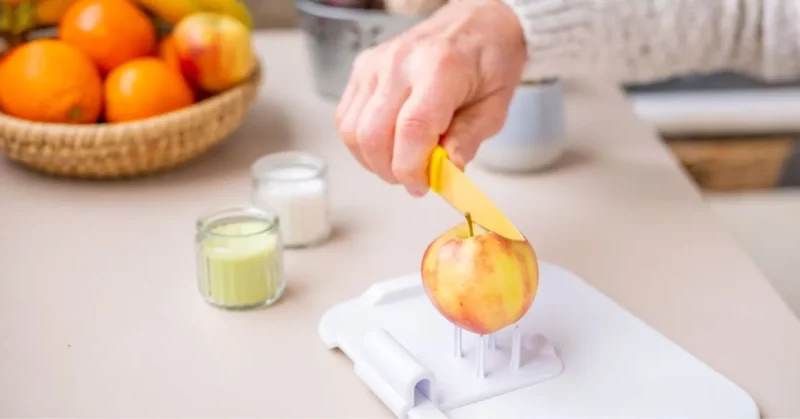
Standard cutting boards slide around easily and have no way to keep foods in position while cutting, which creates a major challenge for individuals using only one hand.
Adaptive cutting boards are designed to stabilize food while preparing meals. Many include:
- Non-slip bottoms
- Raised corners
- Food spikes
- Built-in clamps
These features help hold ingredients in place so the person does not need a second hand for stabilization.
For example, someone recovering from stroke may struggle to hold a potato steady while peeling or slicing it. Without support, the food constantly shifts around the cutting board, making the task frustrating and unsafe.
A stabilized cutting board removes much of that struggle.
This also reduces mental fatigue. When the environment feels more secure and predictable, the brain spends less energy trying to compensate for instability.
Rocker Knives
Traditional knives require coordinated back-and-forth cutting motions that can be difficult with hand weakness or limited coordination.
Rocker knives work differently.
Instead of sawing through food, the curved blade allows the person to cut using a rocking motion. This often provides much better control for individuals with reduced hand function or one-handed limitations.
Many rocker knives also feature larger ergonomic handles that are easier to grip.
While this may sound like a small adaptation, it can dramatically improve independence during meals. Being able to cut your own food again often feels meaningful because it restores a sense of autonomy that many people miss after injury.
Jar Openers
Opening jars becomes surprisingly difficult after neurological injury because it requires:
- Grip strength
- Wrist stability
- Bilateral coordination
- Rotational control
People often blame themselves for struggling with this task when in reality it is mechanically demanding even for healthy individuals.
Adaptive jar openers help reduce that physical demand.
Some mount underneath cabinets while others use electric motors or stabilizing grips to improve leverage. These tools allow the jar to remain steady while reducing the amount of force needed to twist the lid.
Adaptive Utensils That Make Eating Easier
Eating itself can become exhausting after neurological injury.
Many people notice that meals take longer because they need to concentrate on every movement. Others experience tremors, weakness, spasticity, or reduced coordination that makes utensils difficult to control.
Adaptive utensils are designed to reduce some of that effort.
Built-Up Handle Utensils
After a stroke or neurological injury, even holding a fork can become tiring.
Some people notice that utensils slip from their hand. Others grip so tightly that their hand becomes fatigued halfway through the meal. In some cases, reduced coordination makes smaller utensils difficult to control consistently.
Built-up handle utensils can help because the thicker grip requires less precise finger control.
Instead of forcing the hand into a tight pinch position, the larger handle allows the utensil to rest more naturally in the palm.
This matters because many people compensate by overusing their muscles. Over time, that creates more fatigue and frustration during meals.
Built-up utensils are commonly helpful for individuals with:
- Hand weakness
- Tremors
- Spasticity
- Arthritis
- Reduced coordination
Importantly, they often help meals feel less mentally exhausting as well.
Weighted Utensils
Tremors can make eating stressful and embarrassing, especially around other people.
Weighted utensils are designed to provide additional stability during movement. The extra weight helps calm excessive motion and improve control while bringing food toward the mouth.
They do not eliminate tremors completely, but many people find that they reduce spilling and improve confidence during meals.
That emotional side matters too. Some individuals begin avoiding restaurants or family meals because eating feels frustrating or uncomfortable in social settings.
Adaptive utensils can help restore some of that confidence. While some individuals benefit from weighted utensils with built up handles, many weighted utensils look no different than the average silverware, which can help individuals feel more confident and less self-conscious during mealtimes.
Angled Utensils
Limited wrist or shoulder mobility can make eating awkward and tiring.
Angled utensils help by positioning the spoon or fork in a way that reduces the amount of movement required from the arm.
For example, someone with shoulder weakness may struggle to rotate the arm enough to bring a spoon to the mouth comfortably. An angled utensil changes the position of the utensil instead of forcing the body to compensate.
That small adjustment can make meals feel far more manageable.
Adaptive Kitchen and Cooking Tools for Safety
Safety concerns often increase after neurological injury, especially when balance, coordination, cognition, or sensation are affected.
Many people try to push through difficult tasks because they want to feel independent again. However, this sometimes increases the risk of burns, falls, or injuries.
Adaptive kitchen tools can help create a safer environment without removing independence.
Non-Slip Mats
Non-slip mats are one of the simplest but most effective kitchen adaptations.
They help stabilize:
- Bowls
- Plates
- Cutting boards
- Small appliances
- Cups and containers
This matters because uncontrolled movement forces the body to work harder to compensate.
For someone with tremors or one-handed limitations, a sliding bowl may turn a simple task into an exhausting one. Stabilizing the environment reduces both physical effort and mental stress.
Electric Can Openers
Manual can openers require repetitive wrist movement, grip strength, and coordination.
That combination becomes difficult for many people after stroke or neurological injury.
Electric can openers simplify the process considerably. Many operate with a single button and reduce the need for sustained grip strength.
They also improve safety because struggling with manual can openers can increase the risk of cuts or hand strain.
Kettle Tippers
Pouring hot liquids can become dangerous when arm weakness or balance issues are present.
Kettle tippers allow the kettle to remain secured in a frame while the person tilts it forward to pour. Instead of lifting the full weight of the kettle, the frame provides support and control.
This reduces:
- Burn risk
- Shoulder strain
- Wrist fatigue
- Balance demands
For individuals with weakness or tremors, this can make preparing tea or coffee feel much safer.
Adaptive Kitchen and Cooking Tools That Help Reduce Fatigue
Fatigue is one of the most misunderstood symptoms after neurological injury.
People often assume fatigue simply means feeling sleepy. However, neurological fatigue is different. Even small tasks may drain energy quickly because the brain and body are working harder to complete activities.
That’s why energy conservation matters so much.
Perching Stools
Many people try to stand through entire cooking sessions because sitting feels like “giving in.”
In reality, sitting strategically is often one of the smartest adaptations available.
Perching stools allow someone to rest while remaining upright at counter height. This reduces the physical demand of prolonged standing while still allowing participation in cooking activities.
They are especially helpful during:
- Meal prep
- Dishwashing
- Chopping vegetables
- Folding laundry at counters
Importantly, conserving energy during cooking may allow someone to participate more fully in other activities later in the day.
Lightweight Cookware
Heavy pots and pans place significant strain on weak arms and shoulders.
Many adaptive cookware options are designed to reduce lifting demands while improving stability. Some include:
- Two handles
- Lightweight materials
- Heat-resistant grips
- Non-slip bases
This can improve both safety and endurance during meal preparation.
Sometimes the goal is not making cooking effortless. Instead, it is making the task manageable enough that the person can continue doing it consistently.
Smart Kitchen Technology Can Reduce Mental Overload
Cognitive fatigue and memory challenges are common after stroke and brain injury.
Cooking becomes difficult not only because of physical limitations, but because the brain is trying to manage multiple tasks at once.
Smart kitchen technology can help simplify some of that mental workload.
Voice-Controlled Assistants
Voice assistants can help with:
- Setting timers
- Reading recipes aloud
- Creating grocery lists
- Providing reminders
- Answering simple cooking questions
This can reduce the need to constantly stop and remember steps.
For example, someone recovering from brain injury may lose track of timing while preparing multiple items. Voice reminders can help keep tasks organized without requiring constant mental effort.
Automatic Shut-Off Appliances
Automatic shut-off features can improve kitchen safety significantly for individuals dealing with memory issues or fatigue.
Helpful appliances may include:
- Automatic shut-off kettles
- Timed coffee makers
- Smart ovens
- Induction cooktops
These tools help reduce anxiety around forgetting appliances or leaving heat sources on accidentally.
How to Choose Adaptive Kitchen Tools Without Feeling Overwhelmed
One of the biggest mistakes people make is buying too many adaptive products all at once.
Unfortunately, that often leads to clutter and disappointment because not every tool will fit every person’s needs.
Instead, start with the biggest challenge first.
Ask yourself: “What task frustrates me the most right now?”
Maybe it’s:
- Cutting food
- Standing too long
- Opening containers
- Holding utensils
- Carrying dishes safely
Addressing one meaningful barrier often creates the biggest improvement in daily life.
It is also important to remember that recovery changes over time. A tool that feels essential today may become less necessary later as strength and coordination improve.
That’s okay.
Adaptive tools are meant to support independence during the recovery process, not define a person permanently.
Occupational Therapists Can Help Identify the Right Tools
Occupational therapists specialize in helping people perform daily activities more safely and independently.
That includes cooking.
Your occupational therapist can help evaluate:
- Kitchen setup
- Safety risks
- One-handed techniques
- Energy conservation strategies
- Adaptive equipment needs
Sometimes the best solution might not be a product/device at all. Rearranging commonly used items, simplifying meal preparation, or adjusting the kitchen layout may help more than buying additional equipment.
Final Thoughts on Adaptive Kitchen Tools
Cooking after a stroke, brain injury, or other neurological condition can feel very different than it used to. Tasks that once felt automatic may now require more effort, more concentration, or new ways of doing things altogether.
That can be discouraging at times but in many cases, the right adaptive kitchen tools can help reduce some of the physical and mental strain that makes cooking feel overwhelming.
Small changes like stabilizing a cutting board, using lighter cookware, or switching to easier-to-grip utensils can make everyday tasks feel more manageable and less exhausting.
Just as importantly, these tools can help people continue participating in meaningful routines, which can help represent independence, confidence, and a sense of normalcy during recovery.
We hope you enjoyed this article and subscribe to our newsletter for weekly articles just like this delivered straight to your inbox — subscribe here.
Here are some additional articles you might be interested in:
Adaptive Equipment for Stroke Patients: Helpful Tools for Daily Activities
30 One Handed Life Hacks Every Stroke Survivor Should Know
The Best Adaptive Equipment for Traumatic Brain Injury Recovery