
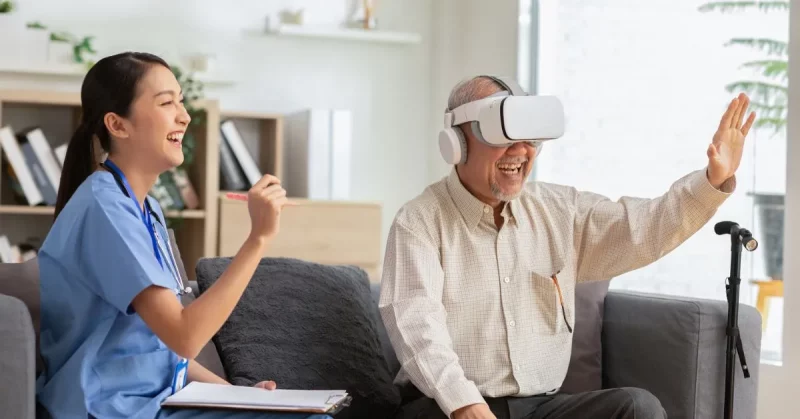
If you’ve ever felt like your physical therapy sessions are a bit of a “rinse and repeat” cycle, you aren’t alone. Recovery after a stroke requires thousands of repetitions to help the brain rewire itself through a process we call neuroplasticity.
But let’s be honest: doing the same arm reach 500 times in a sterile clinic room can feel a bit like watching paint dry.
This is exactly why virtual reality (VR) has moved from the world of video games into the world of neurorehab. It promises to make those thousands of repetitions feel less like a chore and more like an adventure.
But does the science actually back it up or is it just a fancy distraction?
Today, we’re taking a deep dive into the latest research to see if VR is a game-changer for stroke recovery or just a passing trend.
What Exactly Is Virtual Reality in Stroke Rehab?
Before we get into the “why,” let’s talk about the “what.” In the context of stroke recovery, virtual reality isn’t just about wearing a headset and fighting digital dragons. It’s a tool used to create a controlled environment where you can practice real-world movements safely.
There are generally two types of VR used in rehab:
- Fully Immersive VR: This is what most people picture. You wear a Head-Mounted Display (HMD), like a Meta Quest, that completely replaces your surroundings with a digital world. When you turn your head, the world turns with you.
- Non-Immersive or Semi-Immersive VR: You might interact with a screen or a projection. You can still see the room around you, but you’re controlling an avatar on the screen using sensors or cameras (think of it like a high-tech version of a Nintendo Wii).
How VR Talks to Your Brain During Stroke Rehab Exercises and The Science of Neuroplasticity
The reason researchers are so excited about VR in the rehab setting isn’t just because it’s fun. It’s because of how it engages the brain.
Following a stroke, the brain needs to find new pathways to send signals to your muscles and VR helps this happen through a few specific “bio-hacks.”
1. Enhanced Biofeedback
In traditional therapy, you might not realize your elbow is flaring out or your movement is jerky. In a VR environment, the software can give you instant visual or auditory cues. This immediate feedback helps your brain “map” the correct movement much faster than examining your form in a mirror or having a therapist simply telling you to “try again.”
2. The “Gamification” Effect
Research consistently shows that when we are engaged in a goal-oriented task, like catching a digital ball rather than just reaching into thin air, our brains release more dopamine. This neurotransmitter is a key ingredient in the neuroplasticity recipe. It keeps you motivated to do the “one more rep” that makes all the difference.
3. Task-Specific Training
The brain learns best when it practices exactly what it needs to do in real life. VR allows you to simulate “activities of daily living” (ADLs), such as making a cup of coffee or crossing a busy street, all within the safety of your living room.
What Does the Research Say about Virtual Reality and Stroke Rehab?
When you hear virtual reality is being used in the stroke rehab setting, it’s natural to wonder: Is this actually helpful, or just another tech trend?
Let’s take a look at what the research says about virtual reality and stroke rehab.
VR and Upper Limb Recovery
When we look at the data, some of the biggest wins for VR are currently in arm and hand recovery.
In a meta-analysis of 10 randomized controlled trials involving 324 stroke survivors, immersive VR therapy led to greater improvements than conventional rehab alone. Participants showed meaningful gains in upper limb function, including shoulder, wrist, and hand movement, along with better performance in everyday activities like dressing or eating.
What’s important here is where those gains are happening. The research suggests VR is especially helpful for:
Range of motion and joint movement
Improvements were seen at the shoulder and wrist, which are key for reaching, lifting, and positioning the arm. VR tasks often involve repeated, goal-directed movements that help reinforce these patterns over time.
Hand function and control
Participants showed measurable gains in hand function, including the ability to grasp and manipulate objects. This matters because hand recovery is often one of the biggest challenges after a stroke.
Functional use in daily life (ADLs)
Beyond isolated movement, VR was linked to better performance in real-world tasks. That’s a meaningful shift because it suggests improvements are carrying over into everyday activities, not just exercises.
One interesting detail: while strength and movement improved, coordination outcomes were not significantly different from traditional therapy which suggests that coordination for the upper extremity may require more targeted or longer term training.
VR and Lower Limb Recovery
When we shift to lower limb recovery, the benefits of VR look a little different but still meaningful.
In a meta-analysis of 24 randomized controlled trials involving 768 stroke survivors, VR therapy led to improvements in key areas like balance, mobility, and certain aspects of walking compared to conventional rehab. However, the gains are more specific, rather than across every aspect of walking.
What stands out, again, is where VR seems to help most.
Balance and stability
One of the strongest findings was improved balance. This matters more than it might seem at first because better balance is often what allows people to stand longer, move more confidently, and reduce fall risk.
Functional mobility (getting up and moving)
VR helped people move more efficiently during functional mobility tasks. This includes activities such as standing up, walking a short distance, and turning, as would occur when moving from a chair in the living room to the toilet in the bathroom, for example. These are the kinds of movements measured in real-world tests and they translate directly to daily independence.
Step quality (how you walk, not just how fast)
Participants showed improvements in step length, which suggests better control and more coordinated walking patterns. In other words, movement may become smoother and more stable, even if it’s not dramatically faster.
At the same time, a few important limitations showed up across the review. Improvements in walking speed and overall gait were less consistent, with measures like speed and stride length not significantly different from traditional therapy so VR may not dramatically increase how fast someone walks, at least not right away.
The results also depend heavily on consistency and volume, with stronger outcomes seen in those completing around 20 or more sessions, reinforcing how important repetition is in recovery.
Overall, the takeaway is a bit more nuanced than with the upper limb: VR appears especially effective for improving balance and functional mobility while changes in speed or more advanced gait mechanics may take longer or require more targeted training.
VR and Cognitive Recovery
Finally, when looking at cognitive recovery, a meta-analysis of 25 randomized controlled trials involving 1,178 stroke survivors, VR-based cognitive interventions showed meaningful improvements in overall cognitive function.
In particular, areas like executive function (planning, problem-solving) and memory saw improvement which is important as these are some of the core skills people rely on to manage daily tasks, make decisions, and stay independent.
Let’s look at each.
Executive function (thinking, planning, decision-making)
This was one of the strongest areas of improvement. VR environments often require you to process information, make decisions, and adjust in real time similar to real-life situations. As a result, this helps strengthen these higher-level thinking skills.
Memory and recall
Many of the VR tasks involved remembering instructions, sequences, or objects. Over time, this repeated engagement can support improvements in working memory and recall.
Overall cognitive function
When taken together, these gains point to broader improvements in how the brain processes and responds to information opposed to just isolated skills.
At the same time, there are some important limitations to keep in mind. Improvements were not consistent across all cognitive areas.
Skills like attention, language, and visuospatial abilities did not show significant changes compared to traditional therapy, and there was no clear improvement in activities of daily living. The results also suggest that how VR is used matters a lot.
Interventions that included one-on-one guidance, personalized tasks, and longer durations (typically six weeks or more) tended to produce stronger outcomes.
Overall, the takeaway is similar to what we see in physical recovery: VR can be a powerful tool for improving your stroke rehab plan alongside conventional methods but it’s not yet a complete solution on its own.
Final Thoughts: Where Virtual Reality Fits in Stroke Recovery
Virtual reality brings something valuable to stroke rehabilitation but it’s not what most people initially expect.
The research shows real, measurable benefits across physical and cognitive recovery.
However, VR works best when you see it for what it is, which is a tool that helps you practice more, stay engaged longer, and challenge your brain in new ways. It makes repetition feel more purposeful. It provides feedback that helps refine movement and thinking. And in many cases, it helps people stick with therapy when motivation would otherwise fade.
But it doesn’t replace the principles of conventional therapy that we know work for recovery like
- Consistency over time
- High-quality repetitions
- Targeted interventions
- A mix of physical, cognitive, and real-world practice
If anything, VR is a new medium to reinforce these principles so instead of asking whether virtual reality is a “game-changer,” a better question might be:
Does this help me stay consistent and engaged in my recovery?
If the answer is yes, then it’s doing exactly what it’s meant to do.
We hope you enjoyed this article and subscribe to our newsletter for weekly articles just like this delivered straight to your inbox — subscribe here.