
Recovering after a stroke rarely follows a straight path. In the early weeks or months, progress can feel steady. You might notice small wins each day like lifting your arm a little higher, speaking more clearly, or walking a bit farther.
Then, suddenly, things slow down.
You’re putting in the effort, but the changes don’t feel as noticeable anymore. This is often called a stroke recovery plateau, and it can feel frustrating, confusing, and even discouraging.
Here’s the good news: a recovery plateau after stroke does not mean recovery has stopped. More often, it means your brain needs a new kind of challenge.
In this guide, we’ll walk through 10 practical ways to “shock” your brain out of the recovery plateau so you can keep progress moving forward!
Table of contents
- What Is a Stroke Recovery Plateau?
- 1. Change Your Routine (Even Slightly)
- 2. Increase the Challenge Gradually
- 3. Focus on Task-Specific Training
- 4. Add Sensory Input
- 5. Use Mental Practice (Visualization)
- 6. Incorporate Music or Rhythm
- 7. Break Tasks Into Smaller Steps
- 8. Train Both Sides of the Body
- 9. Prioritize Rest and Recovery
- 10. Stay Consistent (Even When Progress Feels Slow)
- A Reminder as You Move Forward in Your Stroke Recovery
What Is a Stroke Recovery Plateau?
At some point in recovery, many stroke survivors notice that their progress slows down. In fact, some research suggests that many survivors experience 70% of their total functional gains in the first 3 months following stroke. Therefore, after this initial recovery period, early gains that once felt steady may begin to feel non-existent.
This phase is often called a stroke recovery plateau.
It is when improvements become harder to see, even though you’re still putting in the work. Research suggests that many survivors experience a recovery plateau approximately 6 to 15 weeks after their stroke occurred.
This can feel frustrating, especially when you’re staying consistent and doing everything you’ve been told to do.
However, it is important to note that this slow down does not mean your brain is done healing.
Instead, it often means:
- Your brain has adapted to your current routine
- Your exercises are no longer challenging enough
- You need more variety or intensity
Because of something called neuroplasticity, your brain is able to rewire and adapt, recovering functions that were lost after stroke. During the first one to three months following a stroke, survivors experience a heightened state of neuroplasticity, and spontaneous recovery of functional skills may also occur.
This can boost recovery, allowing individuals to make rapid gains during this period, particularly if they are participating in targeted rehabilitation.
Although neuroplasticity is only enhanced for the first few months following a stroke, neuroplastic changes continue to occur throughout the rest of your life. This means that the brain can continue to adaptively repair itself, even long after your stroke occured. But for that to happen, it needs the right kind of stimulation.
Think of it this way: your brain changes when it is challenged, engaged, and stimulated repetitively and consistently.
So, let’s explore how to reintroduce that challenge and break through the infamous stroke recovery plateau.
1. Change Your Routine (Even Slightly)
One of the most common reasons progress starts to stall is subtle: the exercises haven’t changed. Repetition is a key part of recovery, but when your brain sees the same movement in the same way over and over, it can begin to “coast.”
That’s often where gains stop happening and recovery seems to plateau.
The good news is that you don’t always need to overhaul your routine to move forward again. Sometimes, small adjustments are enough to challenge your brain in a new way and restart progress.
Some easy changes to help jumpstart your recovery gains again can include:
- Changing the speed of your exercises
- Practicing at a different time of day
- Altering your environment (different room, standing vs sitting)
- Adding small variations to familiar movements
These changes may seem minor, but they give your brain something new to figure out. And that’s often what helps turn a plateau back into progress.
2. Increase the Challenge Gradually
Another common reason progress slows is that the challenge level hasn’t kept up with your improvements. What once felt difficult can start to feel automatic, and when that happens, your brain doesn’t have to work as hard to complete the task.
To keep moving forward, it helps to gently raise the level of difficulty. This doesn’t mean pushing to exhaustion but more about giving your brain and muscles a little more reason to stay engaged.
This might look like:
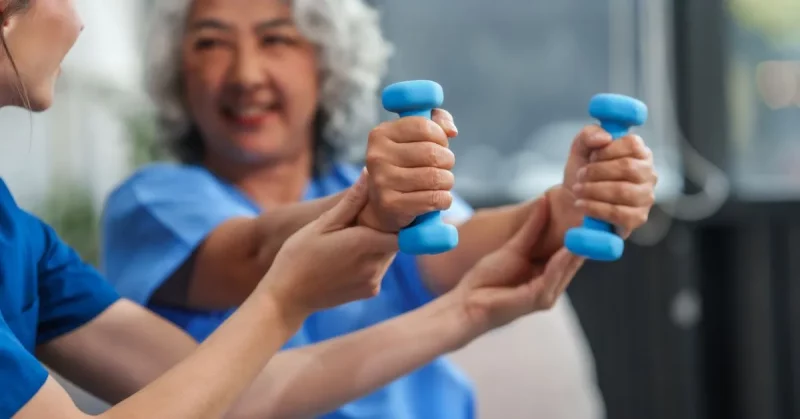
- Adding resistance (light weights, therapy tools)
- Increasing repetitions
- Extending how long or increasing how frequently you practice
- Reducing support (for example, using less assistance from your stronger side)
The goal is to find that middle ground where the exercise feels challenging, but still manageable. That’s usually where the most meaningful progress starts to happen again.
3. Focus on Task-Specific Training
Another way to kickstart your stroke recovery and break through a plateau? Practice movements that carry over to real life and real activities with meaning. Your brain tends to learn best when movements have a clear, practical purpose, i.e. something it recognizes as useful outside of practice.
That’s where task-based training can make a difference. Instead of focusing only on isolated movements, you begin to tie those movements to real-world actions your brain cares about.
For example:
- Instead of just squeezing a ball, practice picking up a cup
- Instead of isolated leg movements, practice stepping or walking
- Instead of finger taps alone, practice buttoning or holding objects
This kind of training helps your brain connect exercises to everyday function and when your brain starts to see that connection, progress often feels more meaningful and more noticeable in everyday life.
4. Add Sensory Input
Sometimes, movement alone isn’t enough to keep progress going. Your brain also relies on feedback to understand what your body is doing and how to improve it.
When that feedback is limited, it can be harder to build strong, accurate connections.
That’s where adding sensory input can help. By giving your brain more information to work with, you make each movement more meaningful and easier to refine over time.
This might include practicing with different textures, like soft or rough objects, or using your vision more intentionally such as watching your hand as it moves or exercising in front of a mirror. You can also challenge your body awareness by briefly closing your eyes during certain movements, or by adding light touch or gentle vibration.
These adjustments may seem simple, but they help strengthen the connection between your brain and body helping you continue to recover.
5. Use Mental Practice (Visualization)
Progress doesn’t always have to come from physical movement alone. Even on days when something feels difficult or out of reach, your brain can still practice in a different way.
Mental rehearsal involves imagining yourself completing a movement, step by step, as if you were actually doing it. This kind of practice can help reinforce the same pathways you’re working on during physical therapy.
For example:
- Picture your hand opening and closing
- Imagine yourself standing and walking
- Visualize completing a daily task successfully
It may feel simple, but research has shown visualization can activate many of the same areas of the brain as real movement. Over time, this can help strengthen those connections and support continued progress, especially when you’re working through a plateau.
6. Incorporate Music or Rhythm
Sometimes, the missing piece isn’t more effort but adding a more dynamic component like rhythm and timing. Rhythm has a powerful effect on the brain and can be a great way to help break through a plateau during stroke rehabilitation. The brain responds strongly to rhythm, and adding a steady beat can make movements feel more natural and easier to coordinate.
Incorporating rhythm into your routine can help guide your timing, improve coordination, and make repetitive exercises feel a little less repetitive. It also tends to increase engagement, which can make it easier to stick with your practice over time.
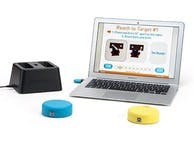
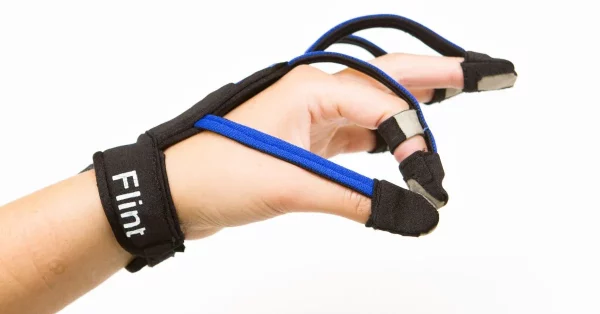
This can be as simple as moving your hand or foot to a steady beat, practicing walking with rhythmic cues, or using music based therapy tools to structure your exercises. Some people also find that music-based therapy tools add an extra layer of feedback and motivation.
When exercises feel more engaging and easier to follow, consistency tends to improve and over time that can help you continue to make progress in your stroke recovery.
Learn more about the MusicGlove for Stroke Recovery
7. Break Tasks Into Smaller Steps
When progress feels stuck, it’s not always about effort. Sometimes the task itself is just too complex for your brain to relearn all at once and when that happens it can help to scale things back and simplify.
Breaking movements into smaller steps gives your brain a clearer place to start. Instead of trying to complete the whole task in one go, you focus on one piece at a time. This makes it easier to build confidence, reinforce the right movement patterns, and create small wins that add up.
For example, instead of practicing “getting dressed,” focus on:
- Lifting your arm
- Guiding it into a sleeve
- Adjusting the fabric
This step-by-step approach creates more opportunities for success. And with each small success, your brain has a better chance to learn, adapt, and keep moving forward.
8. Train Both Sides of the Body
Even if one side of your body has been more affected, recovery doesn’t have to focus on that side alone. In many cases, involving both sides can actually support better progress for the affected side of the body through the cross education effect.
This approach of training both sides of the body, often called bilateral training, can help your stronger side to guide and reinforce movement on the affected side. It gives your brain more information to work with and can help rebuild coordination between both halves of the body.
Some examples to try out:
- Moving both arms together
- Practicing mirrored movements
- Using your stronger side to guide the weaker side
These types of movements can act as a reference point for your brain and over time, they can help “remind” it what the movement should feel like, making it easier to relearn and refine those patterns.
9. Prioritize Rest and Recovery
It can feel counterintuitive, but more practice isn’t always the answer. In fact, one of the most overlooked parts of recovery is giving your brain enough time to rest and process what you’ve been working on.
Every time you practice a movement, your brain is taking in new information. But the real changes like strengthening connections and improving coordination often happen during rest.
If progress feels stalled, it may help to build in more recovery time. That could mean
- Taking short breaks between exercises
- Getting enough sleep
- Spacing practice sessions throughout the day instead of doing everything at once
These pauses can help give your brain the space it needs to absorb and organize what it’s learning and sometimes, that’s exactly what helps progress start moving again.
10. Stay Consistent (Even When Progress Feels Slow)
This may be the most important part of all, even if it’s the hardest to stick with.
Progress in stroke recovery isn’t always something you can see from one day to the next. Often, the real changes are happening quietly in the background and that can make it tough because many times we want to see visible gains!
Consistency is what allows those changes to build. Each repetition helps reinforce the pathways you’re working on, even if it doesn’t feel different right away. Over time, that steady input helps prevent backsliding and creates the momentum needed for progress to show up more clearly.
On the days when things feel slow or frustrating, it can be tempting to do less or skip practice altogether. But even a small amount of effort still counts.
Showing up consistently, even in small ways, is what gives your brain the repetition it needs to keep adapting. And more often than not, that’s what helps turn slow progress into meaningful change over time and break through any stroke recovery plateau you may have hit!
What Matters More for Recovery: Repetition or Consistency?
A Reminder as You Move Forward in Your Stroke Recovery
A plateau during your stroke recovery can feel discouraging and it’s easy to wonder if this is as far as recovery will go.
But in many cases, it’s simply a sign that your brain is ready for something different. By changing your approach, even in small ways, you can continue to support your brain’s ability to adapt and improve.
At the same time, it’s important to stay patient with yourself.
Talk with your doctor or therapist before making major changes, especially if you have other health considerations. Keep your routine simple, and focus on what feels manageable.
We hope you enjoyed this article and subscribe to our newsletter for weekly articles just like this delivered straight to your inbox — subscribe here.