

Watching someone you love recover from stroke is hard. It gets even harder once therapy sessions end and daily practice falls to home. Many caregivers want to help, but aren’t sure where their role starts and ends.
Should you run the exercises, count the reps, or correct their form?
That uncertainty matters because how you support home practice can genuinely affect how much progress your loved one makes between therapy visits.
Skip it, and they may only get the repetition their weekly sessions provide. Overdo it, and you risk burnout, or a role that isn’t really yours to fill.
The good news is that your job here is narrower than it might seem, and more doable too.
In this article, we’ll cover why repetition matters so much for recovery, and five specific ways you can help deliver it at home, without becoming your loved one’s therapist.
Why Repetition Is What Actually Drives Recovery
Recovery after stroke relies on neuroplasticity: the brain’s ability to build new connections when a pathway is damaged. Those connections form through repeated, meaningful practice, not through rest or willpower alone.
That’s also where a real gap shows up.
One study observed actual therapy sessions and found patients completed only about 32 repetitions of an upper mobility task throughout the sessions observed. That’s far short of what is needed to help the brain rewire
In contrast, another study had patients pushed toward 300 repetitions or more in a single hour session and when most reached that number their arm function improve measurably a month later (Birkenmeier et al., 2010).
The Golden Rule of Home Practice: more meaningful repetition, done consistently, is what moves recovery forward. A caregiver’s most valuable job in facilitating home practice isn’t designing exercises but rather helping their loved one get more repetitions, more consistently.
What the Caregiver’s Role Actually Looks Like
Caregivers aren’t and shouldn’t be expected to replace a physical or occupational therapist at home.
Your role is to help make recovery easier to continue between therapy sessions so your loved one can get as many quality repetitions of what they are working on.
That might mean assisting them, keeping accountability by encouraging regular practice, helping set up exercises or equipment, and helping your loved one stay motivated when progress feels slow.
You can also be an extra set of eyes and ears, helping communicate challenges, questions, or changes back to the therapy team when needed.
Simple way to think about your role is as a support system, not the person responsible for delivering therapy.
Here’s what that can look like day to day.
5 Ways to Support Home Practice as a Caregiver
Supporting home practice as a caregiver often comes down to making practice easier to start, easier to stick with, and less frustrating by helping create the right environment and routine around it.
Here are five practical ways to support home practice without taking over the recovery process.
1. Build a Routine You Can Actually Keep
A short routine done most days beats an ambitious one done occasionally. Consistency is what turns repetition into lasting change.
A routine that survives a bad week is more valuable than a perfect one that gets abandoned after two.
A few ways you can help make a home practice routine stick as a caregiver is:
- Pick a consistent time of day, like right after breakfast, so practice doesn’t compete with other decisions.
- Keep sessions short enough to finish on tired days, even 10 to 15 minutes.
- Track completed sessions somewhere visible, like a wall calendar, so progress is easy to see.
2. Help With Movements They Can’t Do Alone Yet
If your loved one can’t yet complete a movement independently, your assistance still counts as practice. Guiding an arm through a reaching motion, or supporting a leg through a stepping pattern, still sends a signal the brain can use to rehearse the pattern.
This is different from compensating for a movement, like switching to the unaffected hand for good. Assisted practice keeps the affected side working toward independent movement, even while it still needs help to get there.
A recent review of passive movement studies found it can meaningfully support motor recovery, particularly early on. Researchers note more high-quality research is still needed to know exactly how much it helps.
Check out our guide to passive range of motion exercises and active versus passive practice for how this can be done safely at home!
3. Tie Practice to a Real Goal
Practice works best when it’s tied to something your loved one actually wants back, not a generic set of exercises.
If the goal is holding a fork again, practice should involve gripping and lifting objects. If the goal is walking to the mailbox, practice should involve standing and stepping.
Ask your loved one what daily task frustrates them most right now, and shape practice around that answer.
4. Increase the Challenge as They Improve
Practice that stays too easy stops driving change. As your loved one gets stronger or more coordinated, the routine should ask a little more of them.
That might mean more resistance, more reps, less support from you, or a slightly harder version of the same task.
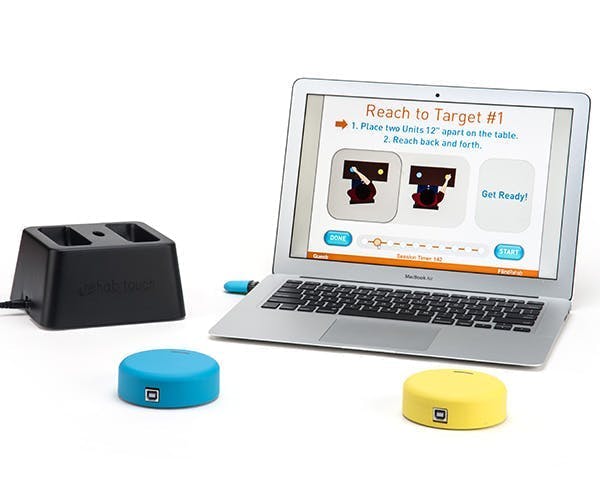
Some tools adjust difficulty automatically as a survivor improves, which takes the guesswork out of when to progress.
One of our home rehab tools, the FitMi, can help track reps and increase difficulty over time. Now while a tool isn’t required to make this work, it can help you notice progress and know when to push a little further.
The key for you is to help them continually stay challenged and moving forward.
5. Know When to Step Back
Not every part of recovery is yours to manage. If a movement causes pain, if your loved one seems to be regressing, or if you’re unsure whether an exercise is appropriate, that’s a question for their therapist.
Don’t try to guess or diagnose at home!
However, this same advice applies to you as a caregiver. One long-term study found that 37.9% of stroke caregivers reported high burden, a marker of burnout risk, just six months after their loved one’s stroke.
In other words, know when to take a step back to protect both your loved one with home practice, but also yourself over the long term!
A good next read for you: preventing caregiver burnout and knowing when to push versus rest.
Moving Forward
There’s no fixed timeline for stroke recovery and no guarantee about exactly how much function will return. What the research does support is this: consistent, meaningful practice gives the brain its best chance to rebuild what it can.
And a caregiver who helps deliver that practice, without trying to run the whole show, plays a real part in it.
Remember, your goal isn’t to replace the therapist in the home. Show up, support, and do what you can to help your loved one get meaningful, quality, and consistent repetitions outside the clinic!
We hope you enjoyed this article and subscribe to our newsletter for weekly articles just like this delivered straight to your inbox — subscribe here.
Here are some additional articles you might be interested in:
- How to Care for a Stroke Patient at Home: 10 Essential Tips for Caregivers
- How to Help Someone Who Had a Stroke: A Guide for Caregivers and Family Members
- How to Prevent and Overcome Caregiver Burnout
- Neuroplasticity After Stroke: How the Brain Rewires Itself to Recover from Injury
- Tired or Overdoing It? Here’s How to Tell When to Push and When to Rest After Stroke