

A stroke recovery timeline tells you what commonly happens. It’s not an expiration date on your progress.”
“How long will my recovery take?” It’s usually one of the first questions stroke survivors and their families ask. The honest answer is that there is no single recovery clock and anyone who gives you an exact date is usually guessing.
But that doesn’t mean we know nothing. Recovery tends to follow patterns that researchers and therapists see again and again. And knowing those patterns can help you set expectations and make good choices at each stage.
In this guide, we’ll take a look at what you can expect in the first days, weeks, months, and years after a stroke. We’ll also cover what you can focus on durign each stage of your stroke recovery and how to keep making progress both inside the clinic and once you are home!
Table of contents
- Stroke Recovery Timeline at a Glance
- What Affects Your Stroke Recovery Timeline?
- First 1 to 3 Days: Stabilizing and Protecting the Brain
- The First Few Weeks: Rehab Begins
- 1 to 3 Months: Often the Most Visible Progress
- 3 to 6 Months: Why Progress May Feel Slower
- 6 to 12 Months: Focused Practice Takes the Lead
- 1 Year and Beyond: Recovery Can Continue
- Meet Some Flint Rehab Stroke Survivors and Their Stories Over 1 Year Post Stroke
- What Matters More Than Time
- Feeling Stuck? Questions to Ask Yourself
- Stroke Recovery Timeline FAQs: Taken Straight From Our Webinar
- Conclusion: Stroke Recovery Takes Time and There’s No Expiration Date on Practice
Stroke Recovery Timeline at a Glance
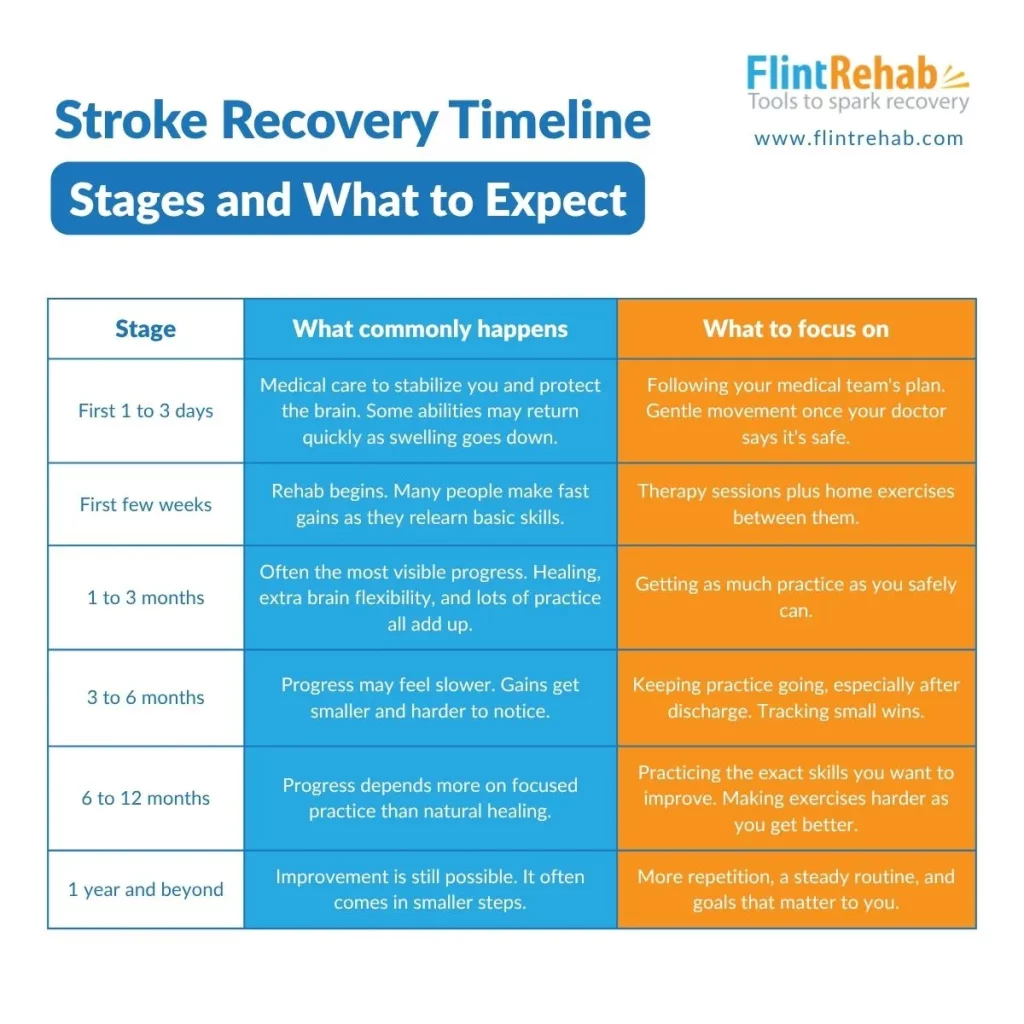
Although everyone’s timeline for recovery after stroke will look a little different, here’s a quick look at what commonly happens at each stage and where to put your energy. Remember to think of this as a guide instead of as a schedule you need to stick to.
What Affects Your Stroke Recovery Timeline?
There are many things that affect how fast you recover after stroke as well as what is possible. Some of these are out of your hands but others you can influence each and every day.
Let’s take a look at each.
Things you can’t control:
- The type of stroke. An ischemic stroke is caused by a clot while a hemorrhagic stroke is caused by bleeding in the brain. You can learn more about each here: Different Types of Strokes: Looking At the 4 Main Types and Subtypes of Stroke With Examples
- Where the stroke happened. Each area of the brain controls different skills. For example, a left hemisphere stroke or temporal lobe stroke can cause a language disorder like aphasia. A right hemisphere stroke affects different skills.
- How severe the stroke was. Doctors often measure this with the NIH Stroke Scale. Minor strokes often recover faster while a massive stroke usually takes longer.
- Which skills were affected. Walking, hand use, speech, and thinking can each recover at their own pace. These secondary effects will affect your specifc challenges as well as shape your rehab plan.
- Your overall health. Age and other health conditions can play a role in your recovery timeline and this is part of why every stroke is different.
Things you can influence:
- How much you practice. More repetition gives your brain more chances to relearn through a process called neuroplasticity.
- How consistent you are. A steady routine beats bursts of effort.
- Access to rehab. Therapy from people trained in neurological rehab can make a big difference.
- Motivation and support at home. Family, friends, and caregivers can help you keep going.
Rehab is the most important factor you can control. Research shows that how therapy is delivered is one of the strongest tools you have for motor recovery. Therapy works best when it is intense, repetitive, and focused on real tasks.
Ongoing practice matters too. In fact, one study found that survivors who didn’t keep up with rehab made little progress between 2 months and 5 years after their stroke. That’s why it helps to set post-stroke goals and keep working toward them.
First 1 to 3 Days: Stabilizing and Protecting the Brain
In the first few days, your medical team has several jobs:
- Treat the stroke quickly, with clot-dissolving medicine or surgery when needed
- Keep you medically stable
- Protect the brain from more damage
- Find out what type of stroke it was and what caused it
- Prevent problems like blood clots or infections
- Check your movement, speech, swallowing, and thinking
When should you start moving? Timing matters here and the research is specific. The 2026 American Heart Association and American Stroke Association rehab guideline recommends gentle, gradual movement, like getting out of bed, starting 24 to 48 hours after a stroke. This should only happen once you’re medically stable and your doctor says it’s okay.
The guideline warns against very early, high-intensity activity in the first 24 hours. In the largest trial to date, starting intense movement that early actually lowered the odds of a good outcome at 3 months. This was especially true after more severe strokes and strokes caused by bleeding. So earlier isn’t always better.
The sweet spot is movement that is structured, gentle, and started within a day or two. Early movement also helps prevent muscle atrophy, or muscle loss from not being used. Your own doctor may recommend something different based on your needs.
Why some skills come back fast. Some abilities can return surprisingly quickly in the first days. Swelling goes down, blood flow settles, and brain areas that were stunned (but not destroyed) start working again. This is called spontaneous recovery.
Those early gains are real but they don’t set the limit on how far you can go. What happens next depends a lot on what you do so let’s take a look at the first few weeks.
The First Few Weeks: Rehab Begins
Many survivors spend about one to three weeks in the hospital. Before you leave, your care team checks how well you can manage activities of daily living, like bathing, dressing, and eating. Then they recommend where to go next:
- Inpatient rehab: at least 3 hours of therapy a day
- Subacute rehab: about 1 to 2 hours of therapy a day
- Outpatient therapy: you live at home and go to therapy sessions
- Home health: therapists come to your home
Wherever you go next, rehab becomes the main focus and depending on what the stroke affected, your plan may include:
- Physical therapy for movement, balance, and walking
- Occupational therapy for daily tasks like dressing and eating
- Speech therapy for talking, understanding, or swallowing
- Cognitive rehab for memory, attention, and problem-solving
- Home exercises to do between sessions
That last one matters more than most people think because your brain changes through experience and repetition. So the practice you do between appointments is part of your treatment rather than just an extra add on. These small extra gains add up to big differences over the long run.
How your brain relearns. You’ll hear the word neuroplasticity a lot. It means your brain’s ability to build and strengthen connections through practice.
Rachel explains it like this: after a stroke, some of the brain’s usual roads to a task are blocked. Neuroplasticity is the brain searching for new roads. Practice is how it figures out which roads to strengthen and keep.
This rewiring works best with practice that is:
- Intensive: enough effort to challenge you
- Repetitive: done many times
- Task-specific: focused on the skill you want back
To learn more, see our guide to neuroplasticity after stroke.
1 to 3 Months: Often the Most Visible Progress
For many survivors, months one through three bring the biggest changes you can see. That’s because several things are happening at once:
- Your brain is still healing naturally
- Your brain is extra flexible and ready to rewire
- You’re likely getting more therapy than you will later
- You’re practicing skills over and over, every day
Put those together and you often get progress you can notice week to week.
Movement in the arm and leg often returns in a common pattern called the Brunnstrom stages of stroke recovery. Knowing these stages can help you and your therapist spot progress.
But this doesn’t mean recovery only happens in the first three months because it doesn’t. These early months are an especially helpful window. They’re just not the only window and it’s very important to remember that!
3 to 6 Months: Why Progress May Feel Slower
Somewhere around months three to six, many survivors start asking new questions. “Why am I not improving as fast? Have I plateaued? Is this as good as it gets?”
If you’re feeling this way, you’re not alone (in fact a survey of 371 stroke survivors it was the most cited challenge). It’s very common at this stage and the full picture is more hopeful than it may feel right now. There are two main reasons progress seems to slow down.
1. Your gains get quieter. Early on, progress is hard to miss. Going from no arm movement to moving it a few inches is a big, obvious change while later gains are smaller but just as real.
You might notice that you:
- Reach a little farther
- Walk more smoothly with better balance
- Open your hand more easily
- Finish a task a bit faster
- Need less help getting in and out of a chair or bed
- Don’t get tired as quickly
These are meaningful changes but they don’t announce themselves as obviously as the early gains. That’s why they’re easy to miss, and why sometimes it can feel like a plateau even when it isn’t.
2. Your practice drops off. During active rehab you might get one to three hours of therapy a day, especially in inpatient rehab. On top of that you’re doing home exercises and relearning daily tasks like getting from bed to chair or using your hand to open a door. That adds up to a lot of practice.
Then you’re discharged. Appointments drop off and practice becomes whatever you keep doing on your own. For many people, practice falls off a cliff right around the time they start feeling stuck.
But the brain didn’t stop responding, the practice slowed down and those are very different problems because the second one is something you can work on.
Remember, slower recovery is not the same as no recovery. Your brain can still change and what is going to drive the change is consistent practice. It’s up to you (with support) to keep up the repetition, the routine and the right level of challenge.
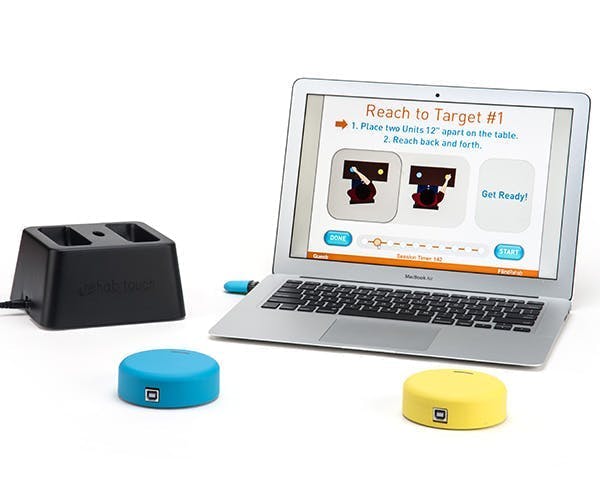
Home therapy tools (like the FitMi home therapy), accountability partners, caregivers, support groups, and more can be helpful after discharge to make sure you stay consistent and keep getting the reps you need.
For tips on keeping progress going, read our guide to the stroke recovery plateau.
6 to 12 Months: Focused Practice Takes the Lead
Between six and twelve months the things that drive your progress start to shift. While early on natural healing does a lot of the work, later progress depends on focused intentional practice.
Common goals at this stage include:
- Walking farther
- Better hand control and finger movement
- Strength and balance
- Coordination
- Doing more daily tasks on your own
- Communication
Walking often keeps improving. In one study, about 60% of survivors who couldn’t walk and took part in inpatient rehab were able to walk on their own at 6 months. If you have hemiplegia or hemiparesis (paralysis or weakness on one side), regular rehab visits and home therapy can help you work toward this goal. You can learn more here about regaining your ability to walk after stroke.
Other skills keep improving too. Studies have found continued gains in function between 6 and 12 months. People with aphasia can also keep improving well after the 6-month mark.
The key at this stage is the goal isn’t juyst to exercise. It’s to practice the exact skills you want your brain to get better at, again and again. If you want to walk better then you practice parts of walking. If you want to use your hand more then practice reaching and grasping.
Continue to build the reps consistently in any way you can!
1 Year and Beyond: Recovery Can Continue
“Can I still improve years after my stroke?” This is the question that keeps many people up at night. Based on current research, the answer is yes. Improvement may still be possible.
For years, therapists were taught that recovery happened in a strict window of 3 to 6 months but newer research has challenged that idea:
- In a study of more than 200 patients, people still responded to therapy well beyond 12 months after their stroke.
- A large study found meaningful gains in function continuing at 12 and 18 months, not stopping at 6.
- Improvement between 3 and 12 months was linked to a lower long-term risk of death and of needing to move into a care facility.
- One study found continued improvements in motor function and self-reported health 1 year after inpatient rehab.
- Another found that over 50% of stroke survivors regained the ability to do their daily activities.
- Research has also documented recovery as far out as 23 years after a stroke.
The catch? Later recovery usually takes more repetition and happens more slowly. It depends on focused practice, and you’ll measure it in smaller milestones.
Rethinking what recovery means. Recovery isn’t only about whether you fully recover and get back to exactly who you were before. It also means gaining function, independence, confidence, and taking part in the life you want to live. By that measure, there is almost always something worth working toward. Work with your therapist to set recovery goals that matter to you.
Healthy habits help at every stage too. Good sleep, daily exercise, a healthy diet, and steps to reduce your risk of a second stroke all support your brain. Joining a stroke support group can also help you stay motivated.
To learn more about making progress years later, read our guide to chronic stroke recovery.
Meet Some Flint Rehab Stroke Survivors and Their Stories Over 1 Year Post Stroke
It’s worth repeating that every stroke is different and therefore every recovery is different. Where one survivor is at the 5-year mark will differ greatly from others. Some find it incredibly helpful to join a stroke support group and gain encouragement and motivation from fellow survivors. It can be motivating to see how others are doing at different moments in their own unique stroke recovery timelines.
1 Year Post-Stroke: Anthony’s Story
Meet Anthony, who experienced left-side paralysis (hemiplegia) after his stroke. He started using FitMi as his home exercise program after 3 months and has continued to improve. He still struggles with hand mobility, which can often take longer to recover than the arm or leg. Nevertheless, hand function can continue to improve with consistent rehabilitation.
2 Years Post Stroke: Mary’s story
Meet Mary, a stroke survivor who was in a coma for 5 weeks after her stroke. She is an example of outstanding recovery, even when her situation seemed grim in the early stages. Mary experienced right-side paralysis and participated in inpatient rehab for another 5 weeks. After two years, she felt like she reached a plateau, but broke through it by pursuing a consistent home exercise program.
3.5 Years Post Stroke: Carol’s Story
Meet Carolyn, a stroke survivor who overcame right-side paralysis. After discharge from inpatient rehabilitation, she used FitMi home therapy to keep improving at home. Now she can drive, ride her bike, and travel with confidence.
11 Years Post Stroke: Becky’s Story
Meet Becky, a brain stem stroke survivor who is going on 11 years of recovery at the time of the video. Brain stem strokes can lead to a condition called locked-in syndrome where the person becomes effectively paralyzed except for the eyes. Becky has come a long way to overcome paralysis and regain mobility. She is living proof of what’s possible with dedication to an intensive rehab program.
What Matters More Than Time
Place after the Survivor Success Stories. Kept short on purpose so it doesn’t overlap with the strategies in the chronic stroke recovery post.
If time alone doesn’t decide your recovery, what does? Research on brain rewiring and motor learning points to five key ingredients. These matter at every stage, from week one to year ten.
- Repetition. Your brain needs to practice a skill many times to relearn it.
- Consistency. One hard session followed by six quiet days does less than an easier routine you can keep up.
- Task-specific practice. Practice the skill you want to improve. To walk better, work on parts of walking. To use your hand, practice reaching and grasping.
- The right challenge. Exercises shouldn’t stay the same forever. As you get stronger, make them a little harder.
- Meaningful goals. Practice works best when it connects to something you care about.
Everyday life counts as practice. Practice isn’t only formal exercise. Cooking, folding laundry, reaching for a cup, walking to the mailbox, and gardening all count. When you turn your daily routine into practice, you get far more reps than therapy alone could give you. And those reps fit into the life you’re already living.
For more ideas, see our guide to activities of daily living after stroke.
Feeling Stuck? Questions to Ask Yourself
If your progress feels stalled, start with a quick, honest check-in. Ask yourself:
- Am I practicing enough?
- Am I practicing on a regular schedule?
- Am I practicing the exact skill I want to improve?
- Is my practice still challenging me?
- Am I tracking my small wins over weeks and months?
- Could a rehab professional help me try a new approach?
If you answered “no” or “not sure” to any of these, that’s a good place to start. Small changes to how you practice can get things moving again.
Important: A sudden change is not a plateau. If you notice a sudden decline or a new symptom, like new weakness, numbness, trouble speaking, or confusion, contact your medical team right away. If symptoms come on suddenly, call 911. Know the warning signs of a stroke.
Stroke Recovery Timeline FAQs: Taken Straight From Our Webinar
My doctor said I’ll never move my arm or walk again. Is that true?
It depends on how severe the stroke was and how much recovery you’ve had so far. Recovery is easier when some nerve connections are still there. In that case, therapy works to strengthen and build on them. If there has been no movement at all since the stroke, the chances are lower.
Your neurologist or rehab doctor knows your case best, so follow their guidance. But watch for small changes, like wiggling your toes or feeling a muscle tighten. These can be signs of recovery that you can build on with practice.
My insurance stopped covering therapy. What should I do?
Many insurance plans limit rehab. Some cap the number of weeks for inpatient rehab or allow around 30 outpatient visits a year. Others end therapy once you stop showing measurable progress. Plans vary, so check with your provider about what yours covers.
When formal therapy ends, your practice shouldn’t. Keep doing the home exercises your therapist gave you. You can also look into a home exercise program or a guided program with remote support.
Is it too late to start rehab 3 to 5 years after a stroke?
No. The same ideas apply years later. If you haven’t practiced much for a while, starting again with a steady, focused routine can lead to real gains. Ask a therapist to recommend exercises that fit your goals.
Why is my therapist working on my shoulder when I want to use my hand?
To use your hand well, you often need strength and stability in your shoulder first. That’s why many therapists start there. It’s still helpful to have hand exercises you can do on your own at home. Ask your therapist which ones are right for you.
Can technology help with recovery at home?
Yes, it can be a great way to add to your practice. Many devices make exercise more engaging and help you get more reps. The best choice depends on your specific needs, so talk with your care team about which options fit you.
Conclusion: Stroke Recovery Takes Time and There’s No Expiration Date on Practice
Since there is no cookie-cutter approach to rehabilitation, every stroke recovery timeline will look different. While there are some general timeframes and milestones, every recovery journey depends on the survivor’s unique circumstances. You will likely see the fastest gains in function in the first 6 months of recovery. However, we know that recovery can continue years after the initial stroke.
Your unique stroke recovery timeline is influenced by some factors that you cannot control, such as your age and the size and location of your stroke. However, there are many factors that you can control, like how often you participate in rehab at home.
Ultimately, the most progress occurs for survivors who believe in themselves and pursue rehabilitation consistently. Your brain needs your help to rewire itself and regain lost abilities.
While progress will likely slow as time progresses, there is always the potential for improvement. Even those in the chronic stage of recovery can see gains in function with consistent therapy exercise. Work closely with your therapy team to create a program that is engaging and helps you reach your individual goals.
We hope this article has provided the insight and hope you need to keep pursuing recovery, no matter where you are in the stroke recovery timeline — for more articles just like this subscribe to our newsletter here.
Need help staying on track? Our Remote Recovery Program pairs you with a neuro rehab coach, in a program built by our PT/OT team here at Flint Rehab. It’s a great option to stay accountable with the right exercises and physical therapist. Your coach builds a home exercise plan around your goals and helps you stay consistent.
Here are some additional articles you might find helpful:
- Watch: The Stroke Recovery Timeline What to Expect at Every Stage: Watch this recorded webinar to see what real recovery looks like at each stage.
- Understanding Your Prognosis After Stroke: Learn the real factors that shape how well and how fast you recover.
- Stuck in a Stroke Recovery Plateau? Here’s Why: Find out why progress can slow down and how to start moving again.
- What Happens When You Leave the Hospital After Stroke: Get a clear guide to the next steps once you head home.
- 10 Stroke Recovery Myths That May Be Holding You Back: Clear up common misconceptions that could be slowing your progress.